.png)
For companies managing employee healthcare plans, onboarding is data-intensive. Historical benefits data needs to be extracted from Explanation of Benefits (EOB) documents, normalized, and loaded into the platform. Automate it poorly, and bad data creates downstream headaches.
One healthcare benefits company had tried automation before. Their previous vendor couldn't deliver the accuracy they needed. When they found a solution that finally worked, they went from signed contract with Sensible to 30 live configurations in under two months.
The challenge: 30 formats, one schema
The company helps businesses in high-turnover industries provide healthcare plans. When onboarding new clients, they process historical EOBs to understand the client's benefits landscape: group numbers, policy details, employee rosters, premium amounts, and deduction breakdowns.
The documents aren't complicated; header information up top, followed by a table of employees with premium and deduction details. The challenge was variety, not complexity. With 20 to 40 different EOB formats from various insurance carriers, each configuration had to produce identical output schemas regardless of format. For a deeper look at this document type, see our guide to extracting data from Explanation of Benefits documents.
Their previous vendor couldn't deliver. Accuracy was inconsistent, and uniform outputs across formats proved difficult.
The solution: Layout extraction with schema normalization
Sensible’s implementation leaned entirely on layout-based extraction. No LLM-based methods required—the documents were structured enough that deterministic methods worked perfectly. EOBs turned out to be easy to configure. The predictable structure made building new configurations straightforward, and when carriers updated their formats, fixes typically took 15 minutes.
The key technical requirement was schema uniformity. Different EOB formats sometimes needed different approaches—most worked with section-based extraction, but some needed table-based methods. The solution was a postprocessing layer that transforms extraction output into a standardized format. Regardless of the underlying method, the final JSON conforms to a single schema, so new EOB formats never require integration changes.
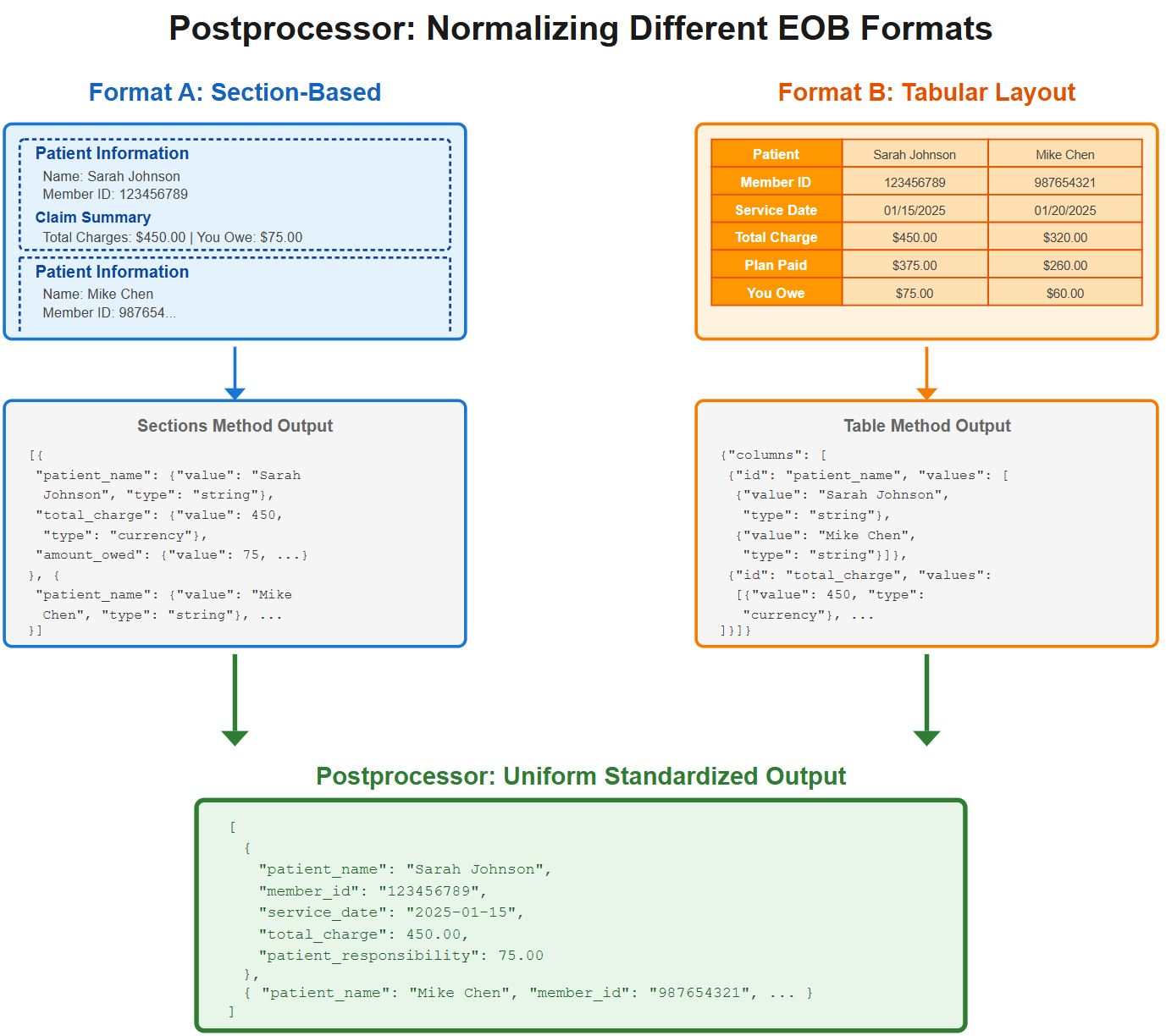
Sensible built this postprocessor capability specifically to close this deal. It's since become a standard feature used across many customers.
The results
The company came prepared with annotated sample documents. Within a month or two of signing, about 30 configurations were live. Volume runs around 100–150 extractions per week, with seasonal bursts during enrollment periods.
Why deterministic methods won
EOBs are structured, repetitive, and list-heavy—exactly where layout-based extraction excels. Anchor on the header, capture the table, iterate through rows. Deterministic methods mean the same input always produces the same output, which is critical for compliance-sensitive healthcare data. In contrast, LLMs can struggle with long lists and introduce unnecessary overhead when documents are already well-structured.
Key takeaways
Simple documents don't need complex methods. When layouts are predictable, deterministic extraction is faster, cheaper, and more reliable than LLM alternatives.
Schema uniformity requires intentional design. A postprocessing layer that normalizes outputs lets you optimize extraction per-format while maintaining integration simplicity.
Match your team structure to the integration. Executive buy-in plus dedicated operational ownership creates sustainable implementations without constant engineering attention. Having annotated samples ready at contract signing enabled a month-to-production timeline.