Sensible vs Hyperscience

Hyperscience targets an SLA.
Sensible runs the rules you write.

Hyperscience is an enterprise platform that sends fields below an accuracy target to human review. Sensible runs the method and the checks your team writes for each field.

Choose Hyperscience if you want fields below an accuracy target routed to human reviewers, with on-premises or SaaS deployment. Choose Sensible if you want to define the method and the checks for each field yourself.

No credit card
·
Sample documents loaded
★★★★★
4.9 on G2 · 14 reviews
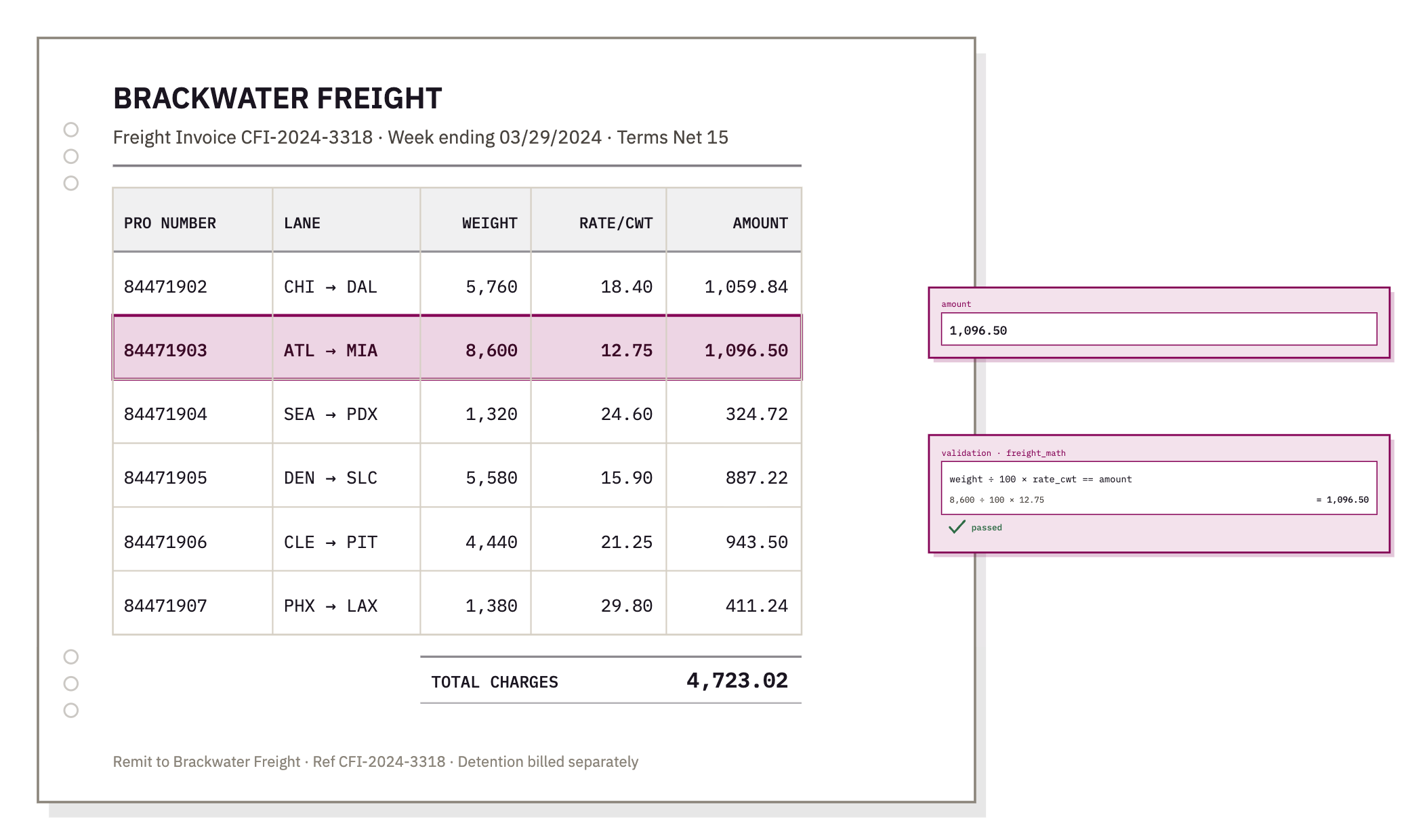
Freight invoice with the extracted amount and a passed weight times rate check.

Per field

Choose an LLM or deterministic method for each field

Per document

Pricing, whatever the page count

SOC 2 + HIPAA

SOC 2 Type II · BAA on Enterprise

No credit card

14-day free trial

Trusted by teams turning documents into production data

Shepherd processed a 351-page Travelers loss run in 31 seconds. Read customer stories

Technical Comparison

Sensible vs Hyperscience

Sensible is a document extraction platform where you choose a method for each field: a deterministic layout method or an LLM. It returns JSON typed to your schema, runs your validation checks, and can include the page and bounding polygon each value came from. LLM query fields return confidence signals, and pricing is per document, whatever the page count.

Hyperscience

Hyperscience is an enterprise document processing platform, the Hypercell Platform, that pairs its ORCA vision language model with human review against an accuracy SLA. It runs on premises, in hybrid clouds or as SaaS, and states FedRAMP High authorization. Its site lists no prices and describes volume-based, per-page pricing.

What we're comparing
Sensible
Hyperscience
The practical trade-off
Extraction Architecture
Hybrid (SenseML Layout Rules + LLMs)
ORCA VLM And Trainable Specialized Models
Hyperscience tunes models on your documents. Sensible lets you choose the method for each field.
Best Use Case
Production pipelines that write document data into a system of record: underwriting, claims, lending, AP, onboarding
Regulated enterprise and public sector work
Its customers include banks, insurers and agencies. Sensible suits teams shipping extraction in their own product.
Complex Table Parsing
Table methods in layout and LLM forms, chosen per table
ORCA 2 extracts tables without a set layout
ORCA 2 added tables without a trained table model. Test your own multi-page tables on both.
Setup Approach
Write a configuration from sample documents, or have Sensible's team build it
Pre-trained ORCA base model, trainable on yours
Both start from a base capability. A specialized Hyperscience model needs a trainer machine with a GPU.
Source Audit Trail
Source lines with page and bounding polygon, via verbosity
Field locations in review and in API output
Both return where a value sits. Compare the coordinate format each API gives your code.
Human Exception Routing
Failed checks flag the extraction for review; LLM fields add confidence signals
Supervision tasks below a confidence threshold
Hyperscience routes on confidence and on custom code blocks. In Sensible, checks your team writes do the routing.
Deployment Options
Hosted on AWS; custom region or on-premises deployment on Enterprise
On premises, hybrid cloud or SaaS
If you need on-premises or air-gapped installs, Hyperscience covers them.
Compliance Status
SOC 2 Type II; HIPAA with a BAA on Enterprise
FedRAMP High authorized through Palantir, per its website
If your agency requires FedRAMP High, Hyperscience states it. Sensible does not list FedRAMP.
Pricing Structure
Per-document pricing: 750 documents on Growth, $0.57 for each extra document
No prices listed; the platform page describes volume-based pricing
Sensible's published plans let you model cost before a call. Hyperscience's pricing starts with a conversation.

Hyperscience details verified November 2026. Sources: Hyperscience homepage, Hyperscience platform page, Hyperscience ORCA docs.

Technical Architecture

How Sensible's hybrid extraction works

A SenseML config picks a layout method or an LLM method per field. Sensible types each value, runs your checks and flags failures.

Document Ingestion
PDFs, Images, Text
SenseML Router
Rule-based orchestrator
Deterministic Engine
Spatial Anchors & Regex
Multimodal LLM Engine
Generative Interpretation
Compute
Type coercion & derived fields
Validate
JsonLogic rule checks
Human Review
Flagged docs, one-click fix
Structured Output
Typed JSON + page positions
Document Ingestion
PDFs, Images, Text
SenseML Router
Rule-based orchestrator
Deterministic Engine
Spatial Anchors & Regex
+
Multimodal LLM Engine
Generative Interpretation
Compute
Type coercion & derived fields
Validate
JsonLogic rule checks
Human Review if flagged
Flagged docs, one-click fix
Structured Output
Typed JSON + page positions
Frequently Asked Questions

Sensible vs Hyperscience: common questions

Does Hyperscience publish its pricing anywhere?
+
Its site lists no prices. Its platform page says pricing is volume-based, with a per-page cost that falls as volume grows. Sensible lists its plans and counts one extraction result as one document, whatever the page count.
Does Hyperscience need training data to start?
+
Its docs say ORCA works out of the box as a pre-trained base model, and you can train specialized models on your own documents. A specialized model needs a trainer machine with a GPU.
Can Hyperscience be installed on premises?
+
Yes. Its platform page says the containerized Hypercell runs on premises, in hybrid clouds or as SaaS, and its docs cover installing ORCA in air-gapped setups. Sensible is hosted on AWS, with custom-region or on-premises deployment on Enterprise.
How does Hyperscience decide what goes to review?
+
You set accuracy targets in the flow, with per-field overrides. Supervision opens below the confidence threshold, and custom code can force review. In Sensible, your checks flag the extraction, and LLM fields return confidence signals.
Does Hyperscience extract tables out of the box?
+
Yes. Its docs say ORCA 2, available from v43.2, extracts tables out of the box, and ORCA 1.0 does not. In Sensible you choose a layout method or an LLM method for each table.
Who writes the extraction logic in each product?
+
In Hyperscience, your team trains specialized models on annotated documents in a no-code trainer and can add rules in custom code blocks. In Sensible your team writes a configuration, or the managed services team builds it.
Is Sensible an alternative to Hyperscience?
+
Yes, for teams that want rule-level control over each field instead of an accuracy-target model.
How does human review work in Sensible?
+
Failed checks flag the document for a hosted review screen, and a webhook fires when a reviewer approves.
Can Sensible run on premises?
+
Yes. On-premises deployment is available on the Enterprise plan.
The Takeaway

Should you choose Hyperscience or Sensible?

Hyperscience if...
  • FedRAMP High authorization your contract requires it, and Hyperscience's website says it is FedRAMP High authorized through Palantir.
  • On-premises or air-gapped installs your data cannot leave your network, and Hyperscience runs on premises, in hybrid clouds or as SaaS.
  • Regulated enterprise references you want a vendor whose named customers include banks, insurers and US federal and state agencies.
  • Review against an accuracy SLA you want to set an accuracy target and have QA and Supervision tasks route the misses to reviewers.
Sensibleif...
  • Extraction logic you can read you want the method for each field and the checks that must pass written in a configuration your team reviews.
  • A hosted API and two SDKs you call extraction from code with Node and Python SDKs and webhooks, and do not want to provision GPU machines.
  • Pricing before a sales call you want to see plans and per-document rates before talking to anyone, with a 14-day free trial.
  • Checks you write yourself you want validation rules you wrote to decide which extractions a person reviews before the data ships.
  • Configurations written for you you want Sensible's managed services team to build and adjust configurations from your sample documents.

Related comparisons: Sensible vs ABBYY, Sensible vs Instabase, Sensible vs Tungsten (Kofax). See also insurance document extraction or all comparisons.

Try Sensible on your documents.

Bring the document your team dreads. If it works on that one, you'll know.

14-day free trial on any paid plan · No credit card