Sensible vs Nanonets

Nanonets runs the process.
Sensible extracts typed JSON.

Nanonets turns business processes into agents, and sells extraction as one block or a separate API. Sensible handles the extraction step and returns typed JSON to your system.

Choose Nanonets if you want a platform that runs the whole document process with agents. Choose Sensible if you want an extraction step your own pipeline calls, returning typed JSON checked against your schema, priced per document.

No credit card
·
Sample documents loaded
★★★★★
4.9 on G2 · 14 reviews
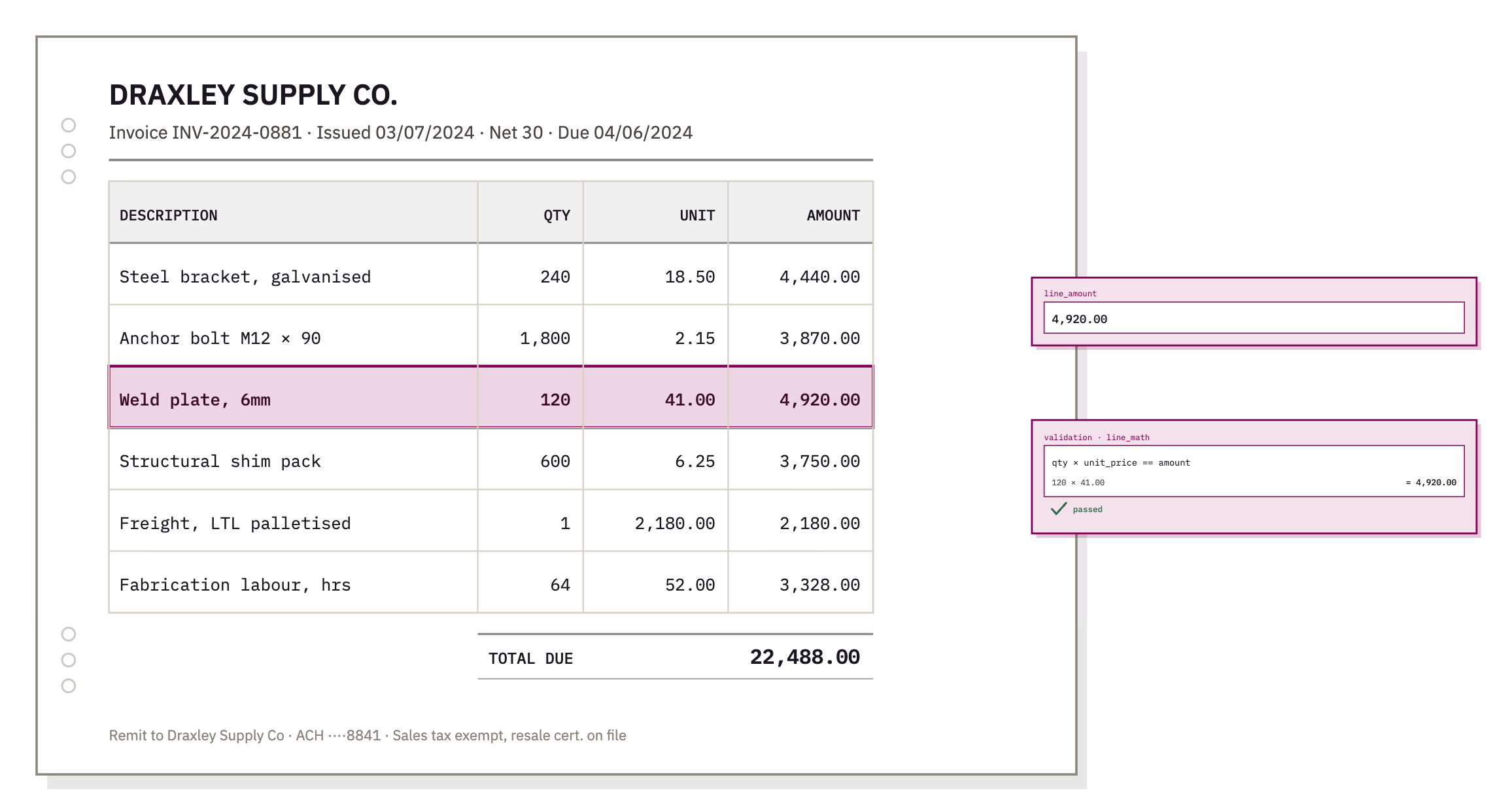
Invoice with the extracted line_amount and a passed line math check.

Per field

Choose an LLM or deterministic method for each field

Per document

Pricing, whatever the page count

SOC 2 + HIPAA

SOC 2 Type II · BAA on Enterprise

No credit card

14-day free trial

Trusted by teams turning documents into production data

Shepherd processed a 351-page Travelers loss run in 31 seconds. Read customer stories

Technical Comparison

Sensible vs Nanonets

Sensible is a document extraction platform where you choose a method for each field: a deterministic layout method or an LLM. It returns JSON typed to your schema, runs your validation checks, and can include the page and bounding polygon each value came from. LLM query fields return confidence signals, and pricing is per document, whatever the page count.

Nanonets

Nanonets is a platform for turning business processes into agents. It parses SOPs into a context graph, extracts data with its OCR-3 model, and sends low-confidence results to a human reviewer. Pricing is per block run, so cost follows the number of steps in the workflow.

What we're comparing
Sensible
Nanonets
The practical trade-off
Extraction Architecture
Hybrid (SenseML Layout Rules + LLMs)
Proprietary OCR-3 Model With Agents
Nanonets picks one model family per workflow, then applies rules. Sensible chooses the method for each field.
Best Use Case
Production pipelines that write document data into a system of record: underwriting, claims, lending, AP, onboarding
Multi-step processes: AP, reconciliation, claims
If the platform should finish the process, Nanonets fits. If your pipeline owns the process, Sensible fits.
Output Format
JSON matching your schema, plus CSV and Excel export
Typed objects, or writes into your systems
Both return schema-shaped data. Nanonets can also push results into ERP and finance systems.
Setup Approach
Describe fields in plain language on day one, or have Sensible's team build the configuration
Upload SOPs, or call the extract API
Nanonets setup can start from policy documents. Sensible setup starts from the fields your system needs.
Source Audit Trail
Page and polygon coordinates for extracted values
Bounding boxes and rule citations
Both trace to the page. Nanonets also cites the business rule behind each agent decision.
Human Exception Routing
Review flags on failed checks, with status API and webhook
Confidence scores, then Slack, Teams or email
Both have a review queue. Nanonets can also route edge cases to Slack, Teams or email.
Deployment Options
Hosted on AWS, SOC 2 Type II; custom region and HIPAA with a BAA on Enterprise
Private cloud or on-prem deployment
Nanonets lists private cloud and on-prem deployment. Sensible lists custom-region and on-premises deployment on Enterprise.
Document Coverage
Your own configurations, plus an open-source library of pre-built ones
Pre-built models, plus zero-shot for any layout
Run your least standard document through both. A coverage list says little about your edge case.
Pricing Structure
Per-document pricing: 750 documents on Growth, $0.57 for each extra document
Per block run: $0.02, $0.10 or $0.30
A six-block workflow costs six runs per document. Per-document pricing does not change with step count.

Nanonets details verified November 2026. Sources: Nanonets pricing, Nanonets docs.

Technical Architecture

How Sensible's hybrid extraction works

A SenseML config picks a layout method or an LLM method per field. Sensible types each value, runs your checks and flags failures.

Document Ingestion
PDFs, Images, Text
SenseML Router
Rule-based orchestrator
Deterministic Engine
Spatial Anchors & Regex
Multimodal LLM Engine
Generative Interpretation
Compute
Type coercion & derived fields
Validate
JsonLogic rule checks
Human Review
Flagged docs, one-click fix
Structured Output
Typed JSON + page positions
Document Ingestion
PDFs, Images, Text
SenseML Router
Rule-based orchestrator
Deterministic Engine
Spatial Anchors & Regex
+
Multimodal LLM Engine
Generative Interpretation
Compute
Type coercion & derived fields
Validate
JsonLogic rule checks
Human Review if flagged
Flagged docs, one-click fix
Structured Output
Typed JSON + page positions
Frequently Asked Questions

Sensible vs Nanonets: common questions

Is Nanonets still a document extraction product?
+
Yes, as one part of a larger platform. Its docs describe turning business processes into agents, and its pricing lists data extraction as a block next to routing and generative AI.
How does a Nanonets context graph differ from a Sensible configuration?
+
Nanonets parses SOPs into a graph of business rules, each cited to its source document. A Sensible configuration is code that defines how each field is read and checked, and it can live in git.
Does Nanonets return confidence scores and bounding boxes?
+
Yes. Its OCR-3 page says each extraction carries confidence scores and spatial coordinates for each element. Sensible returns page and polygon coordinates, and confidence signals on its LLM query fields.
How do per-block and per-document pricing compare?
+
Nanonets charges $0.02, $0.10 or $0.30 per block run and estimates a typical invoice workflow at 4 to 6 blocks. Sensible charges per document, whatever the page count or number of steps. Price your real workflow on both.
Can I run Nanonets in my own cloud or on premises?
+
Nanonets lists private cloud or on-prem deployment and data residency in the US, EU or APAC on its Enterprise plan. Sensible is hosted on AWS, with custom-region or on-premises deployment on Enterprise.
Which suits a regulated healthcare or finance workload?
+
Both list SOC 2 Type II. Nanonets lists HIPAA with a BAA on enterprise plans. Sensible signs a BAA on Enterprise, and on smaller plans when the use case calls for it.
Is Sensible an alternative to Nanonets?
+
Yes, when you need extraction as an API inside your own pipeline rather than a hosted process platform.
Does Nanonets offer an extraction API?
+
Yes, alongside its process-automation agents.
The Takeaway

Should you choose Nanonets or Sensible?

Nanonets if...
  • Agents that finish the process you want reading the document to be the first step of an approval, a match or a claim decision.
  • Rules already written as SOPs your policies exist as documents, and you want the platform to parse them into rules an agent applies.
  • Private or on-prem deployment your security team requires private cloud or on-prem deployment, which Nanonets lists on its pricing page.
  • A small start with credits you want to try it on $50 of free credits before talking to anyone, then move to a $100 monthly plan.
Sensibleif...
  • Extraction is the whole job you want typed JSON matching your schema, handed to a system you control, with the workflow left to your code.
  • Method choice for each field fixed-position fields are read by deterministic rules and variable ones by an LLM, in one configuration.
  • Extraction logic in version control your engineers should review and diff the logic that reads each field, the way they review other code.
  • Cost that follows documents you want one per-document price that does not depend on how many steps your workflow has.
  • Managed services to build it Sensible's team can plan, build and adjust configurations from your sample documents.

Related comparisons: Sensible vs Docsumo, Sensible vs Extend, Sensible vs Rossum. See also accounts payable invoice extraction and Nanonets alternatives, or all comparisons.

Try Sensible on your documents.

Bring the document your team dreads. If it works on that one, you'll know.

14-day free trial on any paid plan · No credit card