
TL;DR
- Nanonets is a no-code workflow platform with OCR and extraction inside it. It now sells itself as a way to turn business processes into AI agents, and it prices by the workflow block rather than by the document.
- Teams look elsewhere when per-block credits make cost hard to forecast, when the extraction sits in a builder they cannot export or version, when their documents outgrow the standard workflows Nanonets is built for, or when they need extraction alone rather than an agent platform.
- Sensible leads this list for teams that want to own their extraction logic: layout rules and LLM methods in one configuration, validation rules that catch bad values before they reach a system of record, published per-document pricing, and managed services for teams that want Sensible to build the configurations.
- The five tools split into five shapes: hybrid developer infrastructure, standard extraction with review, AI-native pipelines, enterprise accounts payable, and no-code parsing.
- No tool copies Nanonets feature for feature. The right pick depends on whether the people doing the work write code, run a queue, or both.
Nanonets earned its place on shortlists by letting an operations or finance team set up document extraction without an engineer: upload samples, train a model, drop it into a drag-and-drop workflow, and route the output to an ERP. For a team with one standard document type, such as invoices in a steady format, that still works.
The teams that go looking for something else usually have a specific story. The bill moved when a workflow grew a step. A model needed retraining after a vendor changed a layout. The product they bought for extraction is now pitched as an agent platform. This guide starts with what Nanonets does and where those teams run into trouble, then compares five alternatives and says which kind of team each one fits.
What Does Nanonets Do and Where Does It Fall Short?
Nanonets is a workflow automation platform built around document extraction. Its homepage headline is "Turn your business processes into AI agents," and the product now includes a visual workflow builder, an OCR model family (OCR-3, published in April 2026), a context graph product called Trail, and an MCP server. The company says it is "used by 35% of the Fortune 500 and 10,000+ enterprises," and reviewers on G2 and Capterra rate it around 4.7 and 4.8 out of 5, praising support, ease of use and the ERP connectors.
Pricing is where most of the friction starts. Nanonets charges per workflow block run: $0.02 for simple operations such as routing, $0.10 for standard AI blocks such as classification, and $0.30 for complex AI blocks such as extraction. Its pricing page says "a typical invoice processing workflow runs 4–6 blocks per document" and lands "under $2 per invoice end-to-end."
Starter begins with $50 in free credits, then $100 a month for 100 credits. Growth needs a sales call, and on-prem deployment, data residency, SSO, HIPAA and SOC 2 commitments all sit on Enterprise. Third-party pricing trackers record three changes to the model since 2024, including the move from per-page to per-block pricing.
The second friction point is ownership. Extraction logic in Nanonets is a trained model plus a workflow assembled in the builder. There is no published way to export it as a file, review it in a pull request, or diff two versions, and the same trackers list model versioning as an Enterprise feature.
The third is complexity. Nanonets is built for simpler, standard document workflows: its pricing page sorts work into simple, standard and complex AI blocks and prices its worked example on an invoice, and its solution pages target accounts payable and order management. Teams with more complex use cases, such as long statements, multi-document packets or layouts that change by issuer, tend to outgrow it. Reviews, each one person's account, point the same way: G2's review summary says manual verification is still needed, a 2026 Gartner Peer Insights reviewer found the customization shallow, and a 2026 one-star Capterra review says accuracy on a three-year account declined until it was unusable.
The fourth is scope and support. A team that bought invoice capture now has an agent platform with context graphs and custom Python blocks. Nanonets lists community support on Starter and dedicated support on Enterprise, and reviews are split: G2 reviewers count support as a strength, while the same Capterra review describes slow support and a refused refund on a prepayment.
The alternatives below fill those gaps in different ways: cost that can be forecast from document volume, extraction logic a team can own, validation inside the product rather than a billed block, room for complex documents, and hands-on help.
Different Alternatives Solve Different Parts of the Document Problem
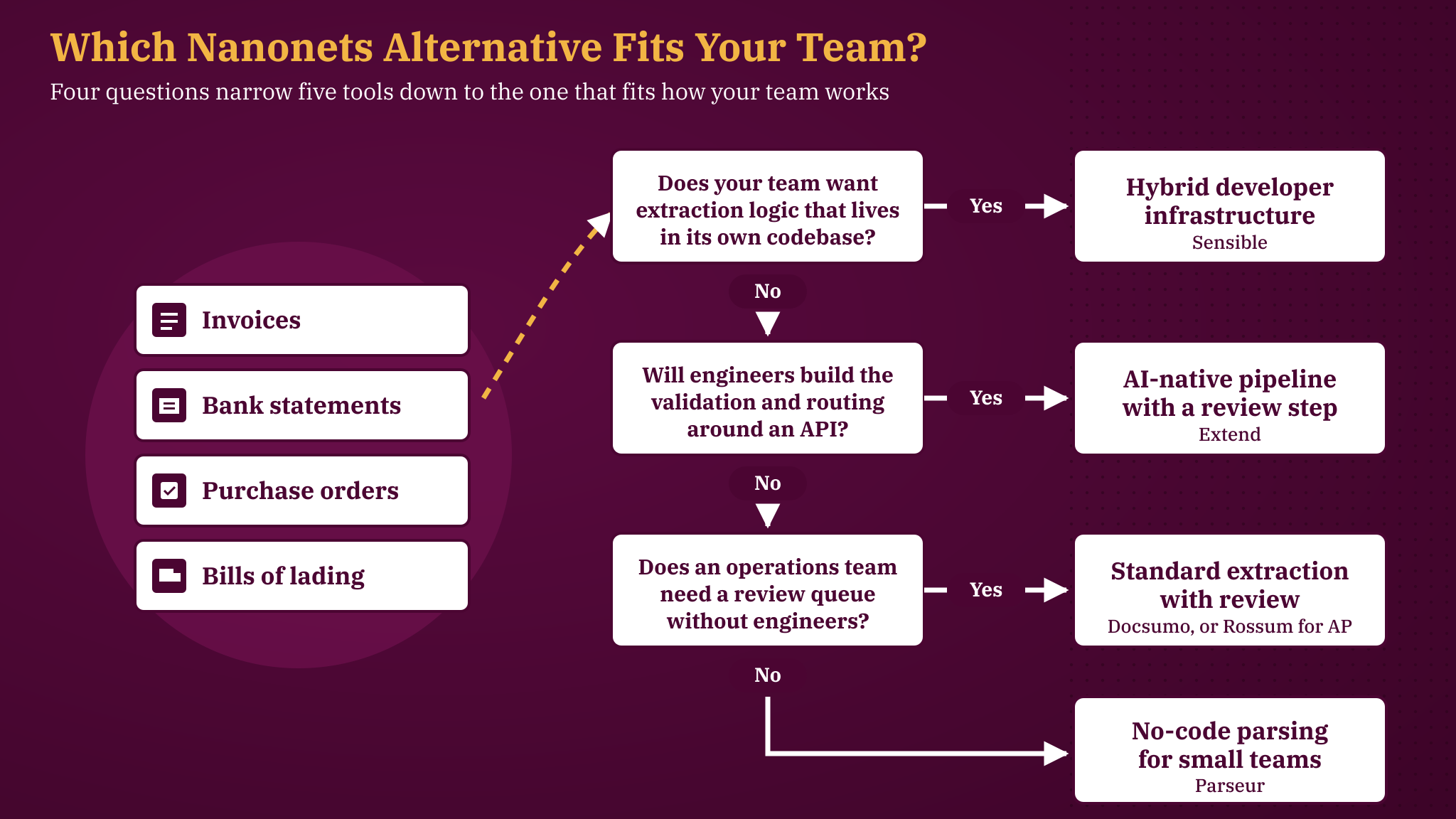
The five tools in this guide do different jobs, and sorting them by shape makes the choice easier than comparing feature lists. A finance operations team and a platform engineering team can both leave Nanonets and land on different tools for good reasons.
| Category | What It Focuses On | Tools in This List |
|---|---|---|
| Hybrid developer infrastructure | Extraction logic written as configuration a team versions and reviews, mixing layout rules with LLM methods, with validation and review built in | Sensible |
| Standard extraction with review | Pre-trained extraction for common finance and insurance formats, with a review queue and case-level checks for operations teams | Docsumo |
| AI-native pipelines | Parse, extract, classify and route steps behind an API, with a review step inside the workflow | Extend |
| Enterprise accounts payable | Invoice and order capture with master-data validation and approval rules, on annual contracts | Rossum |
| No-code parsing | Email and PDF parsing into spreadsheets and automation tools at a low monthly price | Parseur |
Two groups sit outside the list on purpose. Prebuilt developer APIs such as Mindee and the hyperscaler services (Azure AI Document Intelligence, Amazon Textract, Google Document AI) hand an engineering team raw extraction and leave validation, review and routing to be built. Enterprise suites such as ABBYY Vantage and Hyperscience sit above it in price.
The 5 Best Nanonets Alternatives for Document Extraction
1. Sensible: Best for Teams That Want to Own Their Extraction Logic
Best for: Product, operations and engineering teams with complex or mixed document types who want extraction logic they can read and version, written by their own engineers or by Sensible's, at a cost they can model from document volume.
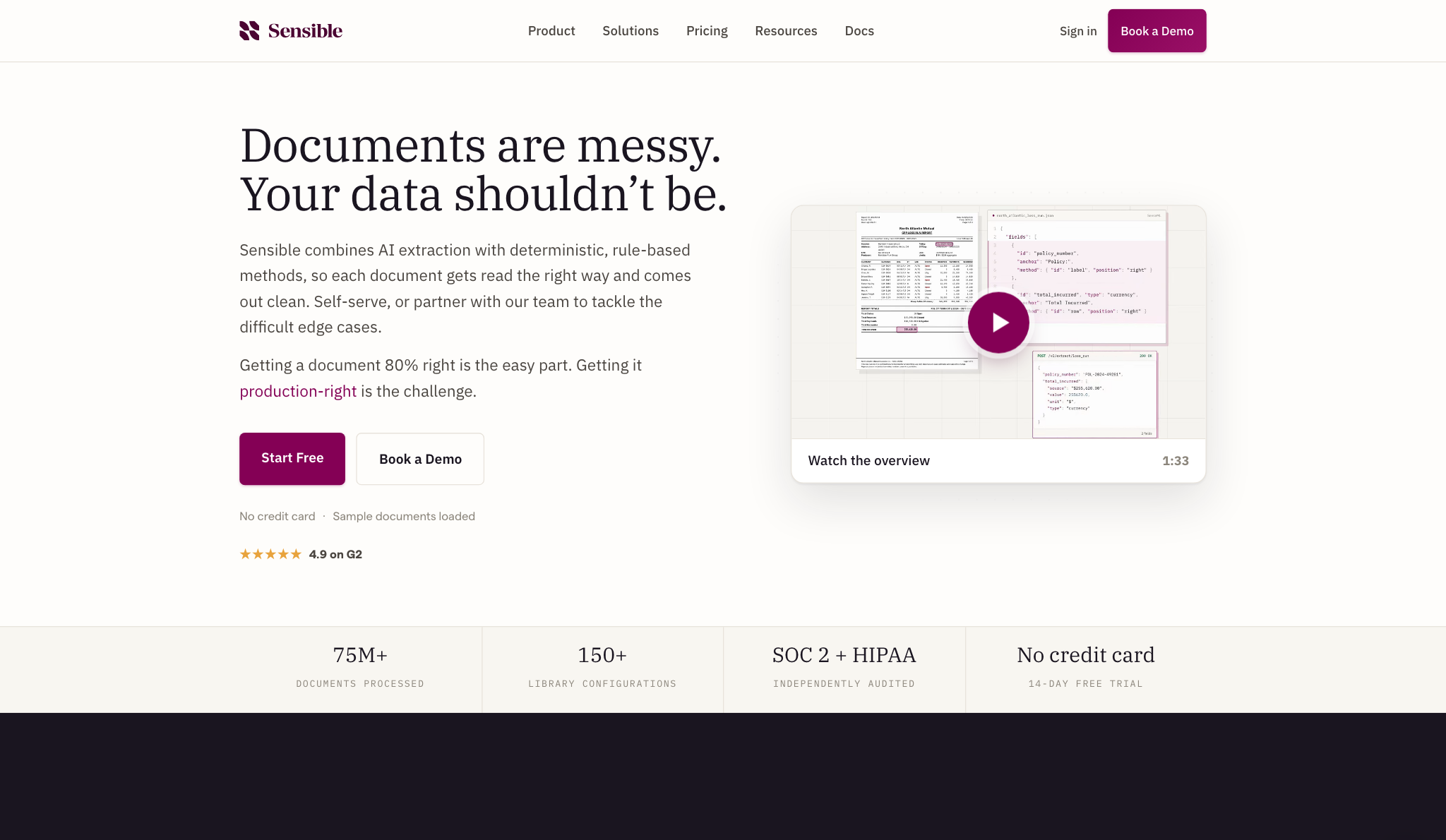
Sensible is a hybrid document extraction platform. Extraction logic is written in SenseML, a JSON configuration in which each field uses either a layout-based method (anchors, rows, regions, tables) or an LLM-based method, and both kinds sit in the same configuration. A configuration is published from development to production and kept as versions, so a fix for one issuer's layout is a reviewable change rather than a retraining round. Through managed services, Sensible's team builds and maintains a customer's most important extractions, or owns the whole pipeline including integrations, and managed customers share a Slack channel with the solutions engineers who wrote their configurations. That suits an operations team coming off a no-code tool without engineers to spare.
Key Functionalities
- Hybrid extraction, chosen per field. Layout-based methods return the same value on every run where the structure is fixed, and LLM-based methods handle the fields that move between layouts.
- Validation rules written against the extracted values, such as transactions reconciling to a stated balance, with error and warning severities. A failed rule sends the extraction to the human review tab instead of letting it pass.
- Typed JSON output against the configuration's schema, with Excel and CSV endpoints, and the source text behind each value shown in the app so a reviewer can trace any number back to the page.
- LLM fields return confidence signals, categorical flags such as answer not found, rather than a probability to calibrate.
- REST API with sync and async endpoints, Python and Node SDKs, webhooks, email intake, Zapier and an MCP server. Document portfolios split a file holding several documents, and classification routes each to the right configuration.
Pros:
- Extraction logic lives in a configuration the team can read, diff and version, not in a trained model
- Published per-document pricing, where a document is one extraction result rather than a page or a file
- Sensible's own solutions engineers can write and maintain the configurations, so a team gets readable, versioned extraction logic without hiring someone to write it
Cons:
- Writing and tuning SenseML is engineering-shaped work, which is what managed services is for
- Routing and delivery happen in your own code, webhooks or Zapier rather than a catalog of native ERP connectors
- No fraud or tampering detection product; integrity checks are rules a team writes
Pricing:Per document. Growth runs $499 per month, or $449 per month billed annually, with 750 documents included and $0.57 per document in overage. Scale runs $1,499 per month, or $1,349 billed annually, with 3,200 documents and $0.53 per document in overage. Enterprise is custom from 10,000 documents per month. Growth includes onboarding support, Scale adds priority technical support, and Enterprise adds a dedicated customer success manager. Every paid plan starts with a 14-day free trial, no credit card required. SOC 2 Type 2 on all plans, with HIPAA BAAs and custom deployments for data residency on Enterprise.
Verdict: The strongest fit for a team leaving Nanonets because its documents got more complex than a standard workflow handles, or because it wants to own the extraction logic and see the cost in advance, whether its own engineers or Sensible's team write that logic. Teams whose first requirement is a visual builder with native ERP connectors will find Docsumo or Rossum closer to that shape.
2. Docsumo: Best for Operations Teams With Standard Documents and a Review Queue
Best for: Lending, insurance and accounts payable operations teams whose documents fall inside a pre-trained set and who want someone to check the exceptions without involving engineering.
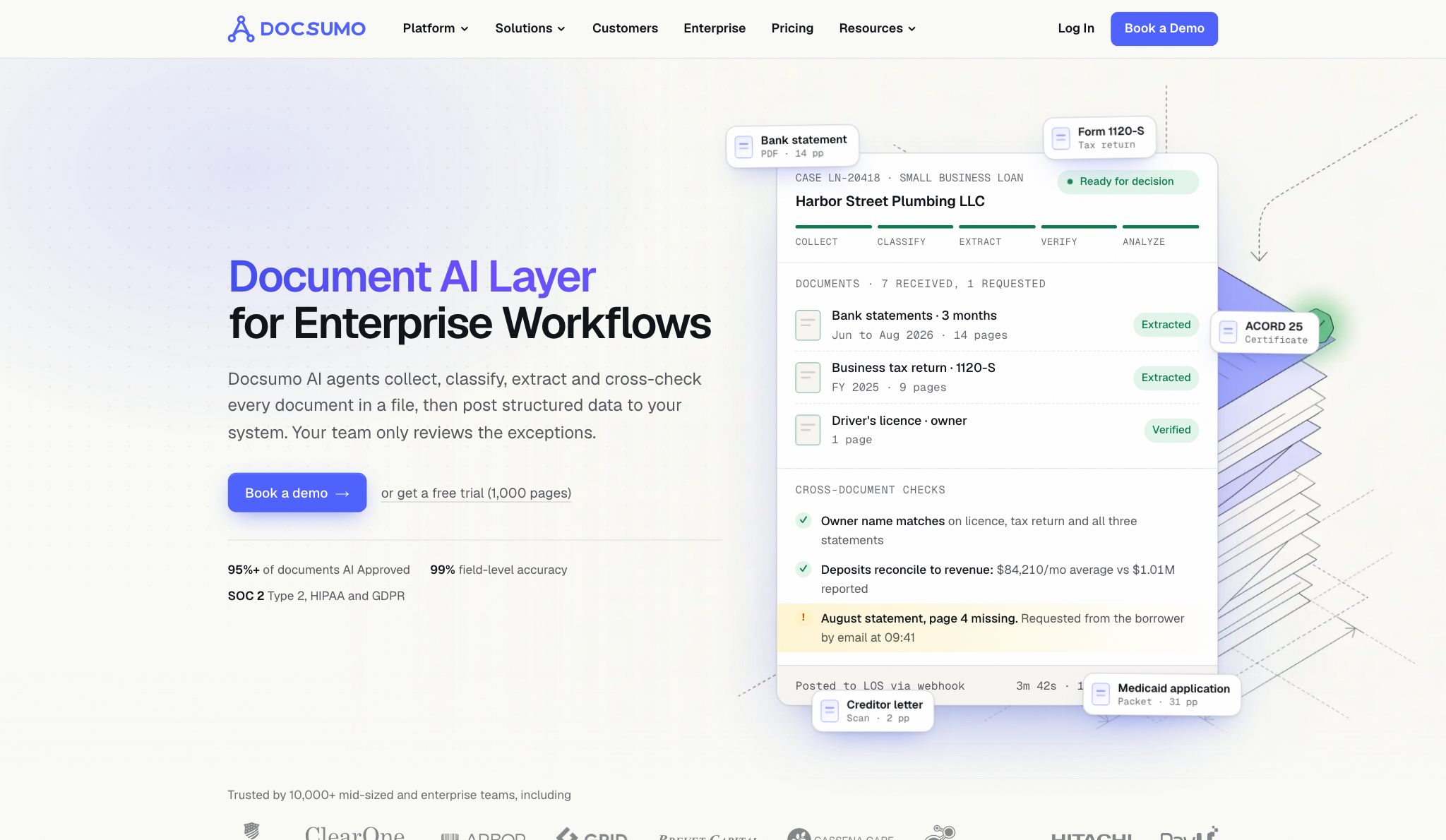
Docsumo calls itself a "Document AI Layer for Enterprise Workflows." Its models run without templates or training data, and its own comparison page claims more than 250 document types, including bank statements, pay stubs, invoices and standard insurance forms. Low-confidence fields land in a built-in reviewer. On Enterprise, case management and cross-document validations let a reviewer check a loan file as a unit, and bank statement transactions are checked against the running balance. Named customers include National Debt Relief, Arbor, Hitachi and PayU.
Key Functionalities
- Pre-trained extraction for common finance and insurance documents, with no model training step.
- A reviewer view with per-field confidence indicators, plus audit logging on the Business plan.
- Cross-document validation and case management on Enterprise, with master-data lookup.
- REST API, webhooks, email intake and ERP posting, with hosting regions in the US, EU, UK, India, Australia and Singapore.
Pros:
- Quick to stand up for document types already in its set, with the review workflow included
- Case-level checks suit lending and underwriting files that arrive as packets
- SOC 2 Type 2, ISO 27001 and a HIPAA BAA on request
Cons:
- No prices are published beyond the trial, and the pricing page states that "setup fees are charged in addition to your subscription plan"
- Page-based metering compounds on long statements and packets
- No on-prem option, which its own comparison page concedes to Nanonets, and third-party reviews report errors on intricate layouts
Pricing: Quote-based. The 14-day trial covers up to 1,000 pages and 10 users. Business and Enterprise are priced on pages processed and workflow complexity, with no per-page rate published.
Verdict: The most direct like-for-like replacement for an operations team that used Nanonets as a review queue in front of an ERP. Teams with unusual layouts or long documents should test it on their own samples first.
3. Extend: Best for Engineering Teams Building a Pipeline With a Review Step
Best for: Engineering and AI teams that want parse, extract, classify and route steps as an API, with a human review step they can switch on inside the workflow.
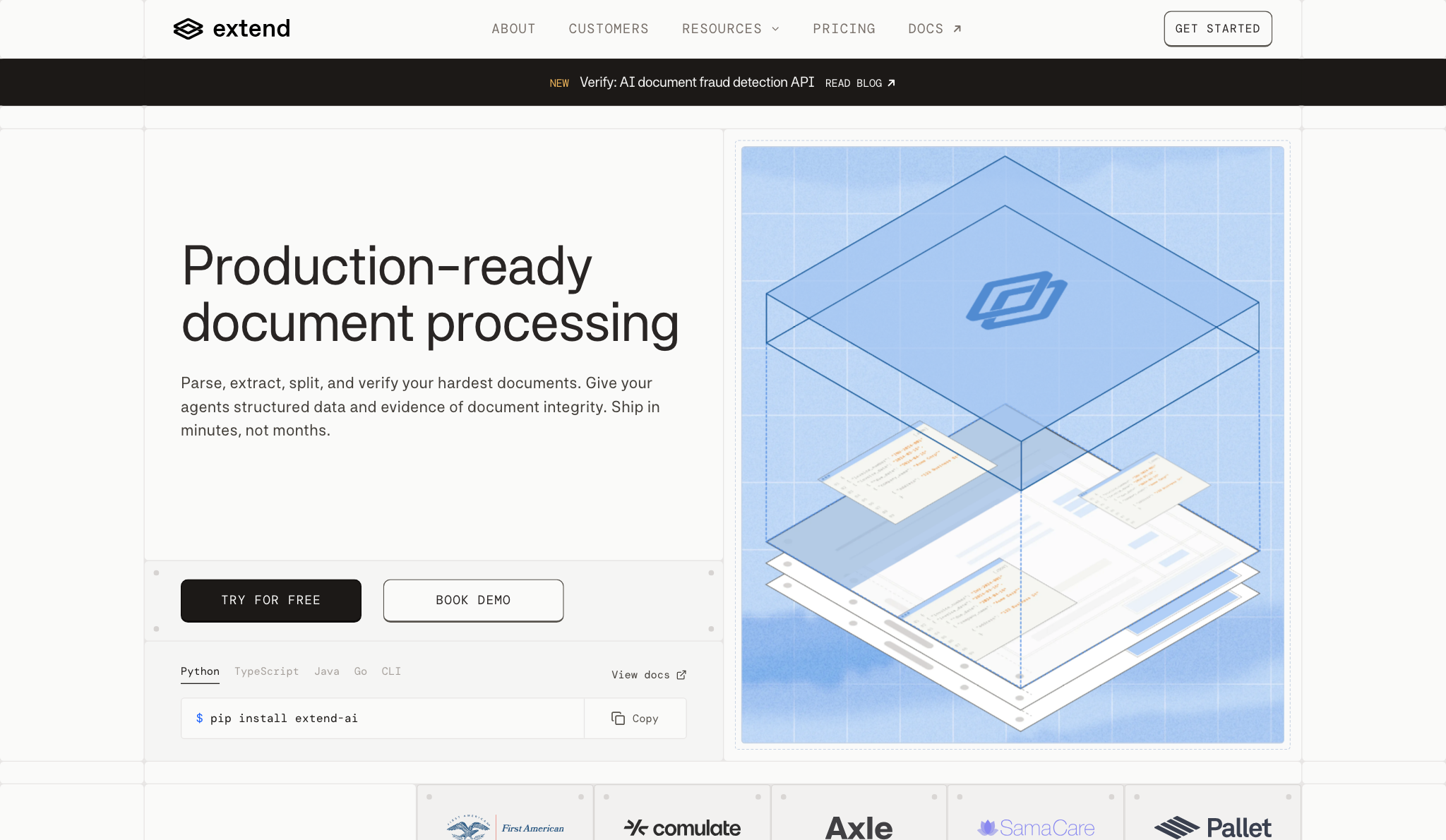
Extend positions itself as "Document Processing Infrastructure for AI Agents." It covers parsing, schema-based extraction with per-field citations, splitting, classification, form filling and a new tamper-detection step. Workflows chain those with validation and router steps, a human review step that pauses a run in a dashboard queue, per-field confidence scores, and workflow versioning. SDKs cover Python, TypeScript, Java and Go, and the customer list on its site includes Brex, Checkr, Square, Mercury and Upstart.
Key Functionalities
- Workflow steps for parse, extract, split, classify, validate, route and human review, with versioning.
- Per-field citations and confidence scores in every extraction.
- Multifile extraction across 2 to 50 files in one run, and 35-plus file types.
- SOC 2, HIPAA and GDPR, with US or EU hosting or deployment in your own VPC.
Pros:
- The only AI-native parser in this group with a published review queue and validation step
- Pay-as-you-go with $100 of free credits and no contract
- Deployment can run inside a customer's own cloud
Cons:
- Built for AI and engineering teams; an operations team without engineers will need setup help
- Credits stack per step, since parse and extract are billed separately
- Accounting and ERP connectors are not published
Pricing: $0.01 per credit with 10,000 credits free. Parsing runs $5 or $20 per 1,000 pages by mode, and extraction adds $7, $30 or $50 per 1,000 pages on top. Growth and Enterprise are custom.
Verdict: A good landing spot for the developers who used Nanonets' OCR API and want a pipeline with a review step they control. Finance teams will find it too code-shaped without engineering support.
4. Rossum: Best for Enterprise Accounts Payable on an Annual Contract

Best for: Accounts payable and shared-service teams at mid-size to large companies that process invoices, sales orders and bills of lading into SAP, Coupa, NetSuite, Workday or Dynamics.
Rossum sells "AI-first end-to-end document automation" on its own transactional language model, Aurora, which it says covers 276 languages and handwriting and learns from user corrections. Validation runs against master data and ERP records, and approval rules route exceptions. Named customers include Wolt, Morton Salt, Port of Rotterdam Authority and Adyen. Coupa acquired Rossum in May 2026, and Rossum's own announcement says the product "lives on under the aegis of Coupa," so its roadmap now sits inside a spend-management platform.
Key Functionalities
- Transactional document capture with master-data validation and automated approval rules.
- Extensions in Python or Node.js, with connectors for SAP, Coupa, NetSuite, Workday and Dynamics.
- ISO 27001, ISO 42001 and SOC 2 Type 2, with EU residency by default and US and Japan available.
- Customer-reported results on its site include a 71% straight-through processing rate at Morton Salt.
Pros:
- Deep AP workflow with validation against the systems finance already runs
- Learns from corrections, with vendor-reported accuracy after a small number of documents
- Strong compliance and residency coverage for European buyers
Cons:
- Starter is listed "starting at $18,000 per year" with a one-year minimum, and the other tiers are not published
- Built around invoices, orders and bills of lading, so a mixed document set is a weaker fit
- HIPAA is not on its security page, and product direction is now a Coupa decision
Pricing: Starter from $18,000 per year with a one-year minimum, priced on pages or documents processed. Business, Enterprise and Ultimate are not published. A 14-day trial is available.
Verdict: A reasonable move for an AP team that outgrew Nanonets and has budget for an annual contract. A team with one small document stream, or anything outside transactional documents, is paying for a platform it will not use.
5. Parseur: Best for Small Teams Parsing Emails and PDFs Into a Spreadsheet
Best for: Small operations teams that receive invoices, purchase orders, shipping documents or lead emails by email and want the fields in Google Sheets, Airtable or a webhook without code.
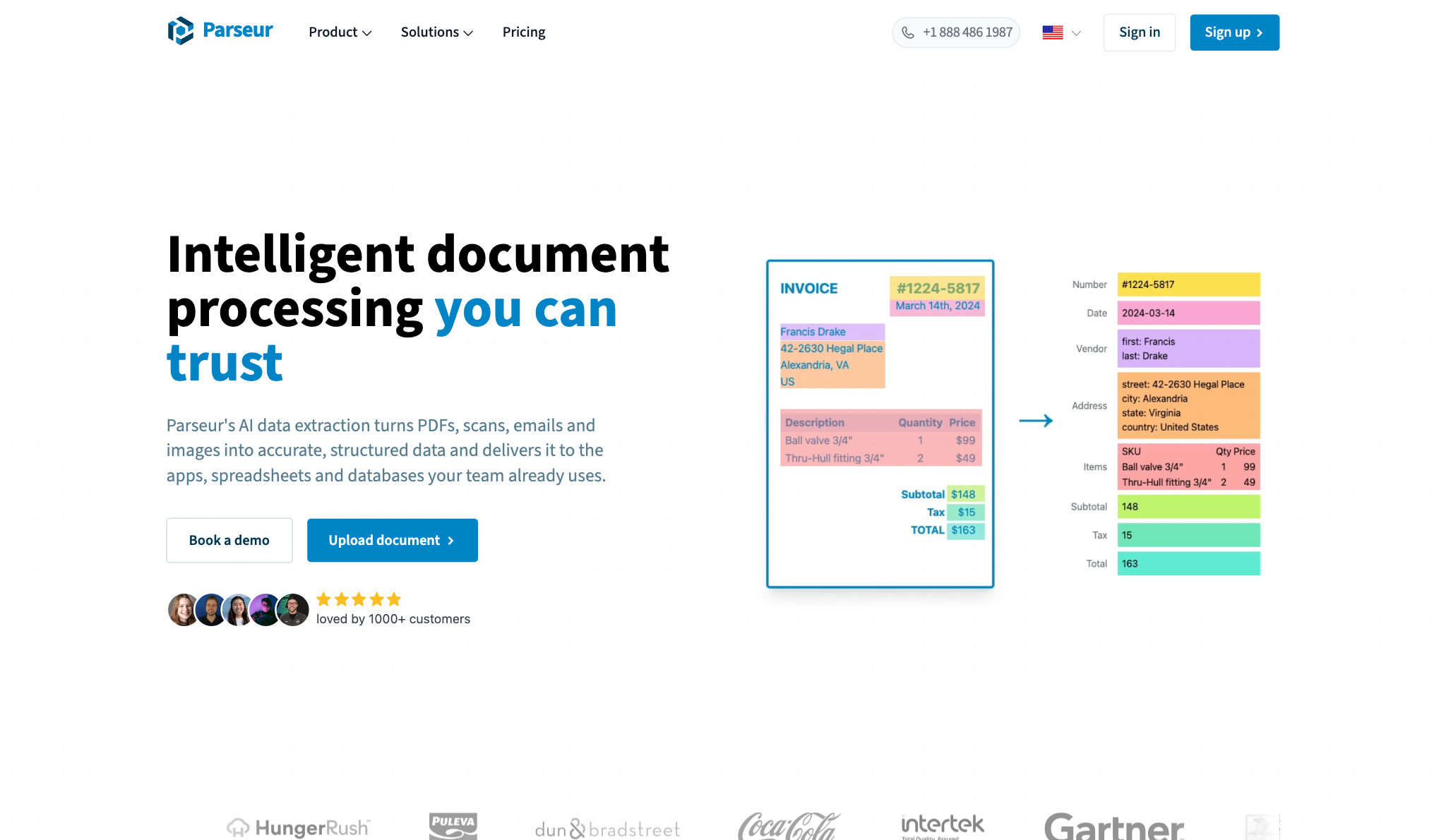
Parseur's homepage reads "Intelligent document processing you can trust." It parses email bodies, attachments and PDFs with point-and-click templates or an AI engine where you describe each field, then sends the result to Google Sheets, Excel, Zapier, Make, Power Automate, Airtable, Salesforce or a webhook.
Key Functionalities
- Template and AI parsing of emails, attachments and PDFs, at one credit per page.
- Native exports to spreadsheets and automation platforms, plus an API and webhooks with retries and delivery logs.
- Published plans from a free tier of 20 pages a month up through self-serve tiers to an Enterprise quote.
- EU hosting, GDPR, and a SOC 2 Type 2 report through its trust center.
Pros:
- The lowest entry price in this list, with every tier published
- Email intake and spreadsheet delivery are the core product
- No contract, cancel any time
Cons:
- Parseur's own help pages say OCR templates support only simple tables and that the AI engine is probabilistic with limited debugging
- No confidence scores, validation rules, review queue or audit trail are published
- No overage rate: at the plan quota, documents stop processing until a top-up or upgrade
Pricing: Free for 20 pages a month. Paid plans run from $49 a month for 100 pages and $129 for 1,000 pages to $499 for 10,000 pages, with larger published tiers above that and up to 25% off for annual billing.
Verdict: The right move for a team that only ever used a fraction of Nanonets, with simple documents and a spreadsheet at the end. Multi-page statements, nested tables or a compliance requirement will outgrow it quickly.
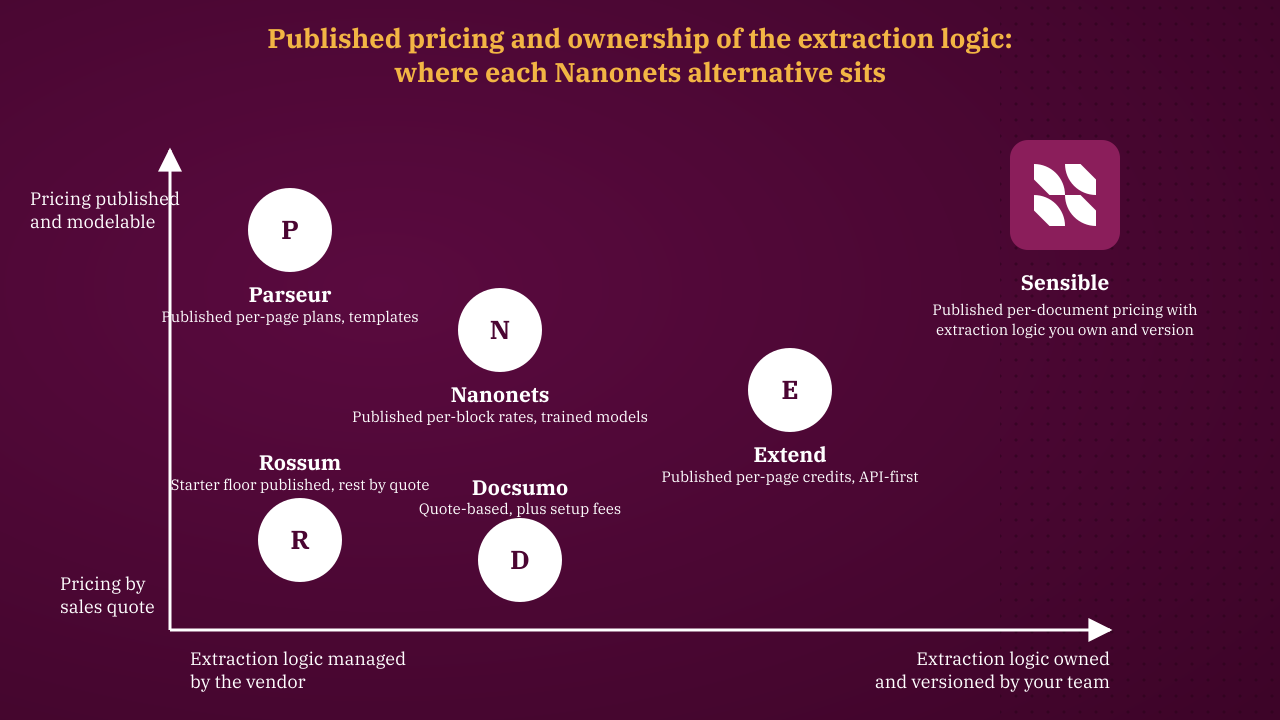
How Do These Five Nanonets Alternatives Compare Side by Side?
Star ratings reflect strength within each dimension, not an overall rank. "Not applicable" means the dimension sits outside what that product is built to do.
| Tool | Handles Layout Variety | Validation and Review Built In | Pricing Predictability | Developer Control | Best For |
|---|---|---|---|---|---|
| Sensible | ★★★★★ | ★★★★★ | ★★★★★ | ★★★★★ | Teams that want to own their extraction logic |
| Docsumo | ★★★ | ★★★★ | ★★ | ★★★ | Operations teams with standard documents and a review queue |
| Extend | ★★★★ | ★★★★ | ★★★ | ★★★★★ | Engineering teams building a pipeline with a review step |
| Rossum | ★★★ | ★★★★★ | ★★ | ★★★ | Enterprise accounts payable on an annual contract |
| Parseur | ★★ | Not applicable | ★★★★★ | ★★ | Small teams parsing emails and PDFs into a spreadsheet |
Which Nanonets Alternative Fits Your Team?
The table above shows what each tool does. This one answers a narrower question: given a specific kind of team and job, which tool goes first on the shortlist.
| Tool | Best Buyer Profile | Primary Use Case | Key Differentiator |
|---|---|---|---|
| Sensible | Product, operations and engineering teams with complex or mixed documents, with or without engineers to spare | Extraction built into a product or an operations pipeline, validated before data lands | Versioned configuration mixing layout rules and LLM methods, written by your team or by Sensible's managed services team |
| Docsumo | Lending, insurance and AP operations teams | Review-queue extraction for standard finance documents and case packets | Case management and cross-document checks on Enterprise |
| Extend | Engineering and AI teams | Parse, extract and route pipelines with an operator review step | Review and validation steps inside an API-first workflow |
| Rossum | Mid-size to large AP and shared-service teams | Invoice, order and bill of lading capture into an ERP | Master-data validation and approval rules, now inside Coupa |
| Parseur | Small operations teams without engineers | Email and PDF parsing into spreadsheets and automation tools | Published plans from a free tier, with no contract |
Conclusion: Match the Tool to the Reason You Are Leaving
Nanonets remains a fair choice for simpler work: a finance operations team with consistent, standard documents that wants a visual builder and native ERP connectors. Teams with more complex documents usually need more than that, and each reason for leaving points at a different tool.
Sensible fits teams with complex documents that want to own their extraction logic and know the cost from document volume, with a managed services team that builds and maintains the configurations when they would rather not. Docsumo fits operations teams with standard documents and a review queue. Extend fits engineers building a pipeline. Rossum fits enterprise AP. Parseur fits small teams with simple documents. The shortest route to the right answer is to run the same twenty documents through the two closest candidates and compare the output against what the team needs downstream. Sensible's comparison with Nanonets covers the two products head to head.
FAQs
What is the best alternative to Nanonets?
Sensible is the strongest fit for teams that want to own their extraction logic, with layout rules and LLM methods in one versioned configuration, validation rules that catch bad values, and published per-document pricing. Docsumo is the closest like-for-like option for an operations team that mainly used Nanonets as a review queue.
Why do teams look for Nanonets alternatives?
The common reasons are per-block credit pricing that is hard to forecast, a trained model that cannot be exported or versioned, documents more complex than the standard workflows it is built for, the retraining effort reviewers describe, and a product now positioned as an AI agent platform when the team only needs extraction.
How does Nanonets pricing work?
Nanonets charges per workflow block run: $0.02 for simple operations, $0.10 for standard AI blocks and $0.30 for complex AI blocks such as extraction. Its pricing page says a typical invoice workflow runs four to six blocks and costs under $2 per invoice.
Which Nanonets alternatives publish their pricing?
Sensible, Extend and Parseur publish prices: Sensible per document from $499 a month, Extend per page through credits, Parseur per page from a free tier. Docsumo publishes only its trial terms, and Rossum publishes only a Starter floor of $18,000 a year.
Is Nanonets an OCR tool or an agent platform?
Both, in 2026. Nanonets still publishes OCR models and an extraction API, with OCR-3 released in April 2026, but its homepage now leads with turning business processes into AI agents.
Can I move my Nanonets workflows to another tool?
No alternative imports a Nanonets model or workflow. A move means rebuilding the extraction logic in the new tool, which is why owning that logic as a readable configuration matters the second time around.
Does Sensible require training a model?
No. Sensible extracts with SenseML configurations rather than trained models. A configuration mixes layout-based methods for fixed structure with LLM-based methods for fields that vary, and a layout change is a change to the configuration, not a retraining round.
Can Sensible build and maintain the extraction for us?
Yes, through managed services. On the hybrid tier, Sensible's team builds and maintains your most important extractions while your engineers handle integrations. On the fully managed tier, Sensible owns the whole pipeline, including integrations and custom scripts.