
TL;DR
- Ocrolus is a lending-focused document platform with strong bank statement analysis and fraud detection, but its pricing is unpublished and its extraction runs as a managed service rather than logic a team owns.
- Teams look for alternatives when human review slows response time, when data has to stay in a specific region, when document variety grows past lending, or when they need published pricing before a sales call.
- Sensible leads this list for varied financial documents, with extraction that does not depend on a back-office review step, custom region deployment on Enterprise plans, and published per-document pricing.
- The five tools split into four shapes: hybrid developer infrastructure, enterprise IDP, fraud-aware extraction APIs, and no-code workflow automation.
- No single tool replaces Ocrolus across every dimension, so the choice comes down to which gap in the current setup costs the most.
Financial services teams run on documents that were never designed to be parsed. A bank statement from one issuer looks nothing like a statement from another, pay stubs vary by payroll provider, and tax forms arrive as scans, photos, and exports. Every lender, fintech, and bank ends up solving the same problem: turning that mixed pile into reliable, structured data before an underwriter or a downstream system touches it.
Ocrolus built its business around that problem for lenders, and it earns its place on most shortlists. This guide starts with what Ocrolus does and where teams outgrow it, before comparing five alternatives and which kind of team each one fits.
What Do Lending-Focused Document Platforms Do and Where Do They Fall Short?
Ocrolus is an AI-powered platform that automates financial document analysis for lenders. It processes bank statements, pay stubs, and tax forms, with a published accuracy claim of 99 percent or higher, and layers analysis on top of extraction: fraud and tampering detection, cash flow analytics for small business lending, and income calculations for mortgage underwriting. Customers include Enova, Better, SoFi, PayPal, and Zillow, and the platform plugs into loan origination systems through an API and a dashboard.
That specialization is the product's strength and the source of its limits. Ocrolus combines automation with human review, which backstops low-confidence extractions but adds turnaround time. Sensible’s comparison page describes the mode that includes human review as taking minutes to hours, which is prohibitive for any workflow where response time is important. Reviewers on Capterra, 16 of them at a 4.6 out of 5 average, praise bank statement verification and fraud flagging, while recurring complaints include slow processing on some banks, with a few reporting waits of 30 to 60 minutes, and occasional missed fields that need manual checking.
Pricing is the other common friction point. Ocrolus doesn't publish rates, and third-party estimates place per-statement costs roughly between $0.50 and $2.00 on annual contracts. A team that needs a quote before it can compare vendors has to start a sales conversation first.
Flexibility and deployment are the last two friction points. Ocrolus is built around bank statements, pay stubs, and tax forms, and according to Sensible’s comparison page it needs training on a team’s own document corpus, with hundreds of examples, for optimal accuracy, so a document type or use case outside its core set can take longer to bring online. Teams with data-residency requirements also need to confirm whether a vendor can process documents in a specific region before they commit.
The gaps the alternatives below fill fall into five groups: response time, deployment in a specific region, flexibility to support new document types, document coverage beyond lending, and pricing that can be modeled before a call.
Different Alternatives Solve Different Parts of the Document Problem
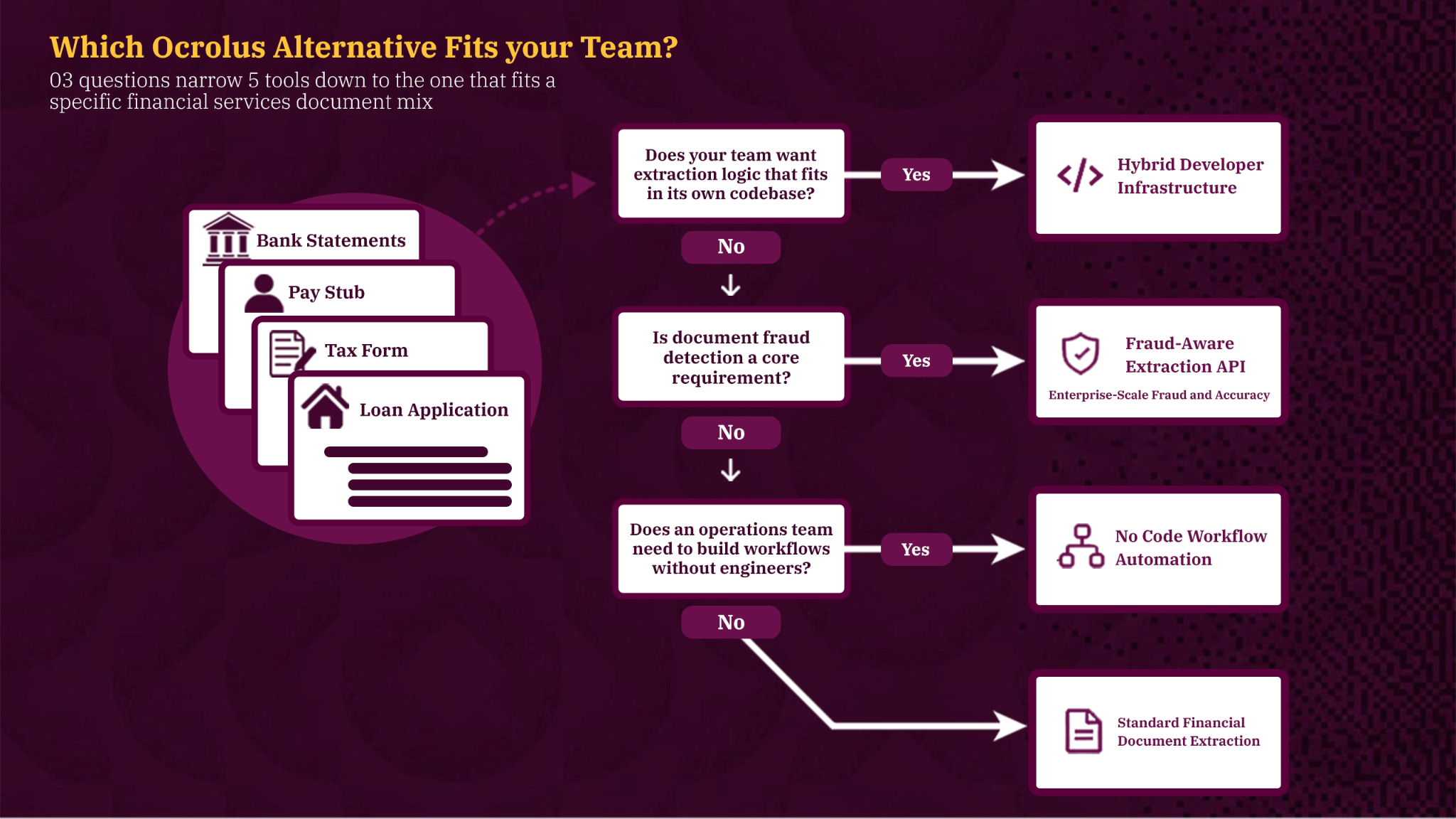
The five tools in this guide solve different problems, and grouping them by shape makes the choice easier than ranking them on one scale. The table below sorts each tool by the problem it is built around.
Hybrid developer infrastructure suits teams that treat extraction as part of their product. Enterprise IDP fits large institutions standardizing document handling across departments. Standard extraction covers the common formats without much customization, fraud-aware APIs add document integrity checks to extraction, and no-code automation puts the workflow in an operations team's hands.
The 5 Best Ocrolus Alternatives for Financial Services Teams
1. Sensible: Best for Developer-Owned Extraction Across Varied Financial Documents
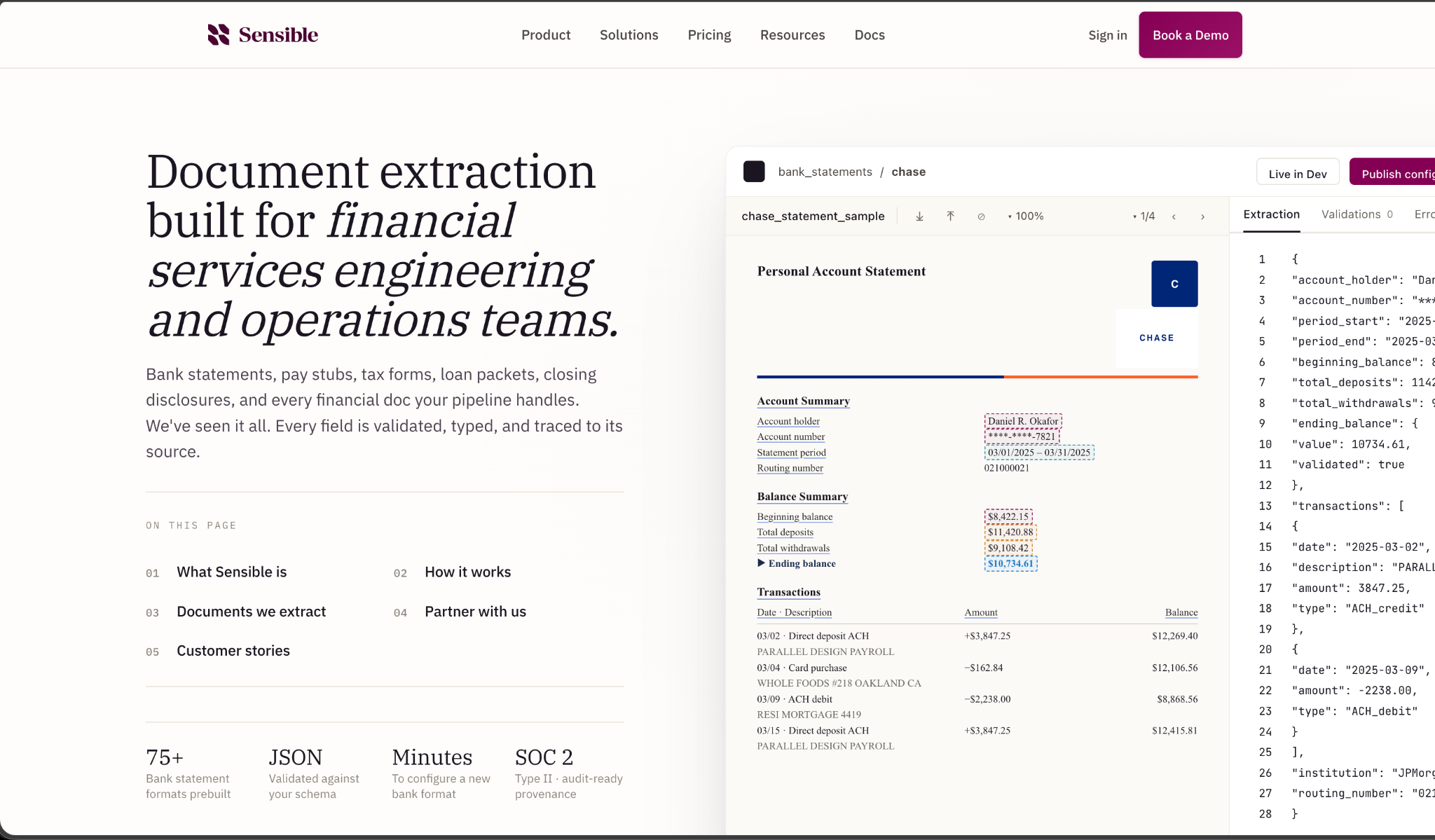
Best for: Product, operations, and engineering teams at lenders, banks, and fintechs that process a varied document mix, need results without a review-queue delay, and want pricing they can model before talking to sales.
Sensible combines layout-based extraction with LLM parsing under one schema-validated API, using SenseML, a configuration language that runs the pipeline of OCR, layout analysis, LLM parsing, and type casting. On the financial services side, it covers bank and brokerage statements with line-level transaction extraction, using layout configurations for formats it has already mapped and a general LLM configuration for everything else, pay stubs from providers including ADP, Gusto, Paychex, and Intuit, tax forms including 1040, 1099, W-2, K-1, 1120, and 1065, loan applications, mortgage closing disclosures, and KYC documents. Document types outside that library are within reach too: teams can build their own configurations, or have Sensible’s managed services team build them from their own sample documents and adjust them when a format changes, so use cases across financial services are not limited to a fixed set.
Key Functionalities
- Hybrid extraction pairs deterministic layout rules with LLM parsing. Layout rules return the same value on every run where structure is predictable, and the LLM handles the sections that vary.
- Results return without a back-office review step. In Sensible, you can write validation rules against the extracted values, for instance, confirming that line items sum to a stated subtotal, and any field that fails gets flagged for review instead of passing through unverified. For context, Shepherd’s lead engineer recorded a 31-second response time on a 351-page insurance loss run.
- Custom region deployment is available on Enterprise plans. Customers can select their preferred AWS region, and Sensible’s security overview says it has supported data-residency requirements with custom deployments, so teams with regional compliance obligations can have their data reside where they need it.
- Fields are typed and returned in one schema, and you can write validation rules, such as cross-field reconciliation, that flag any value that fails. The Sensible app highlights the source text behind each extracted value, so a reviewer can check any number against the original page.
- Configurations are versioned, testable, and deployable through CI/CD. A fix for one issuer's statement format lives in Git instead of in one person's head.
- Integration runs through REST, Python and Node SDKs, and webhooks. Webhook support handles asynchronous processing for long or high-volume files.
- Security covers SOC 2 Type II, with HIPAA compliance available on Enterprise plans. The Sensible app highlights the source text behind each extracted value, which supports audit and regulatory review.
Pros:
- Handles a wide mix of financial document types without a retraining step for each new format
- Per-document pricing stays predictable regardless of page count or complexity
- Source-coordinate traceability gives reviewers and auditors a direct path from output to original page
Cons:
- Writing and refining SenseML configurations is closer to engineering work than a point-and-click setup
- The financial services page describes extraction and validation rather than a dedicated tampering-detection product comparable to Ocrolus Detect
- Underwriting analytics such as cash flow and income calculations are logic a team builds on the structured output, not a prebuilt layer
Pricing: Per document. The Growth plan runs $499 per month, or $449 per month billed annually, with 750 documents included and $0.57 per document in overage. The Scale plan runs $1,499 per month, or $1,349 per month billed annually, with 3,200 documents included and $0.53 per document in overage. Enterprise pricing is custom, starting at 10,000 documents per month. A 14-day free trial is available with no credit card required.
Verdict: The strongest fit for a financial services team that needs varied documents extracted with fast response times, optional region-specific deployment, and room to add new document types, whether it builds the configurations itself or has Sensible’s managed services team build them from its own samples. Teams that want a finished lending analytics suite with fraud detection built in will find Ocrolus closer to that shape.
2. Hyperscience: Best for Enterprise-Scale Accuracy Across Regulated Departments
Best for: Large banks and financial institutions that need one platform handling documents across multiple regulated departments, with top-end accuracy and review workflows as hard requirements.
Hyperscience converts unstructured and handwritten documents into structured data across financial services and other regulated sectors. For financial services it lists loan and mortgage applications, KYC forms, account agreements, compliance and audit reports, financial statements, and trade confirmations. The company claims 99.5 percent accuracy on loan, account, and compliance data and 98 percent automation on loan processing. Named customers include Charles Schwab, American Express, CI Financial, and Westpac, and CI Financial reports a 60 percent reduction in case processing times.
Key Functionalities
- Accuracy claims run at 99.5 percent for extraction of loan, account, and compliance data, with IDC listing the platform as a shortlist candidate for high-accuracy and handwriting use cases.
- Fraud and duplicate detection analyze patterns across documents and prevent the same document from processing twice.
- Review workflows resolve entity mismatches by presenting likely candidates from a system of record for a person to select.
- An API-first, modular architecture integrates with banking systems including FIS Global, Bloomberg Terminal, and Jack Henry.
Pros:
- High published accuracy claim with independent analyst recognition
- Proven in large banking deployments with named enterprise customers
- Handles handwritten documents that many extraction tools struggle with
Cons:
- Pricing isn't published, so every engagement starts with a sales conversation
- Positioned toward large enterprise deployments, a heavier engagement than a smaller lender or fintech usually needs
- Lending-specific analytics such as cash flow and income calculations aren't highlighted on its financial services page
Pricing: Not publicly disclosed. The platform is sold through a sales-led enterprise process.
Verdict: A strong choice for a large financial institution standardizing document automation across departments, particularly where handwriting appears in the mix. Smaller teams that want transparent, self-serve pricing will find the sales-led model heavier than they need.
3. Docsumo: Best for Standard Financial Document Extraction With Review Workflows
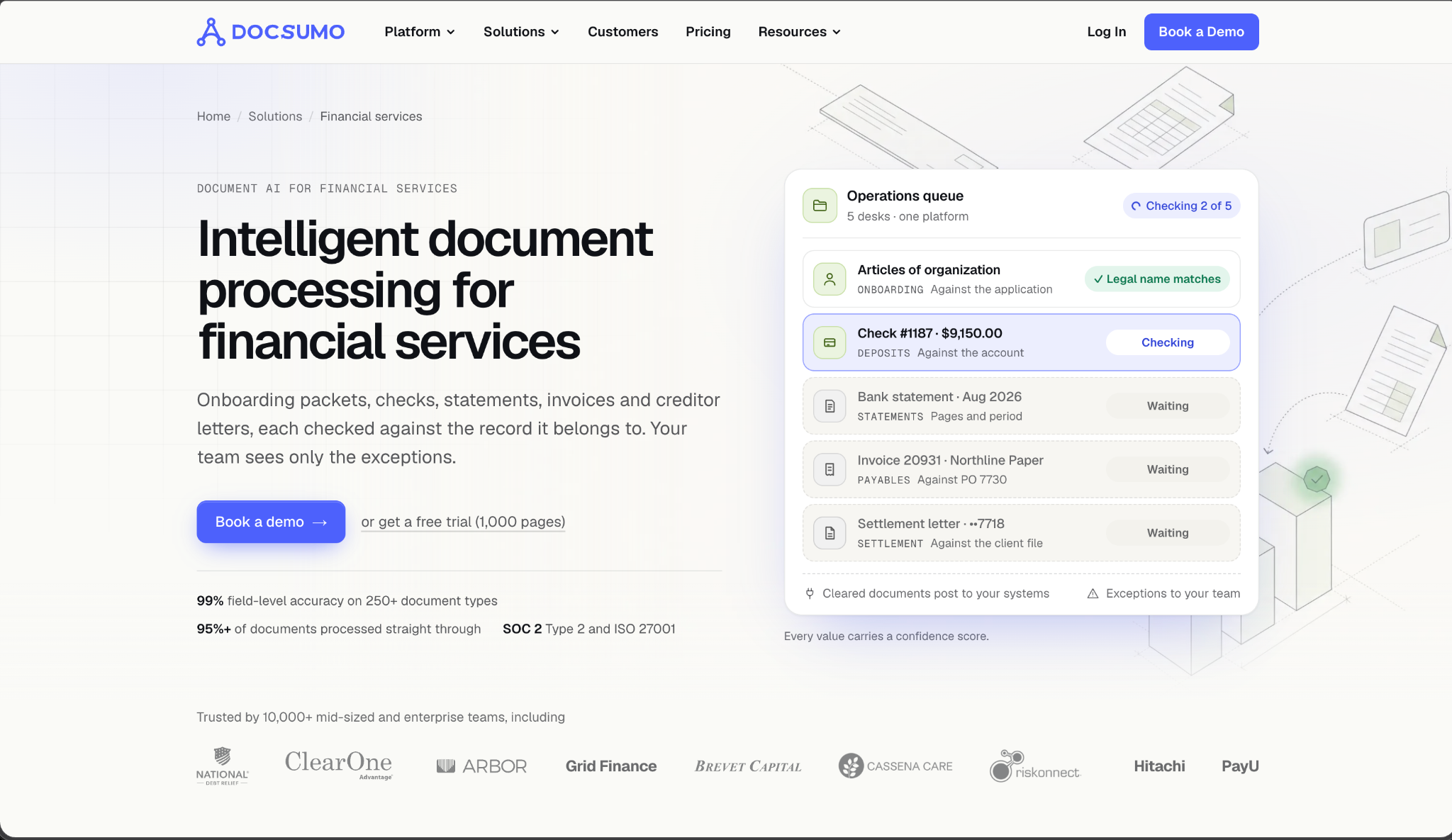
Best for: Teams processing common, relatively consistent financial and insurance documents that want pre-trained extraction and a document review step, without much layout variety to handle.
Docsumo covers more than 250 pre-trained document types, including financial documents and standard insurance forms and certificates of insurance. The platform includes field and table extraction, an AI document reviewer, prebuilt integrations, APIs, and webhooks, with auto-classification and custom pipelines on the Business plan and cross-document validations and AI case management on Enterprise. For a team whose documents fall inside its core set, the setup is quick and the review workflow is built in.
Key Functionalities
- Pre-trained extraction covers 250-plus document types, so common formats work without model training.
- An AI document reviewer supports human checks on extracted fields before data moves downstream.
- Cross-document validations on Enterprise compare values across related documents in a case.
- APIs, webhooks, and prebuilt integrations connect output to existing systems.
Pros:
- Fast to deploy for standard document types already inside its pre-trained set
- Review workflow is part of the product, not a separate build
- Free 14-day trial covers up to 1,000 pages and 10 user licenses
Cons:
- Teams report an accuracy ceiling as document variety, length, or table complexity grows past the pre-trained types
- Pricing depends on pages processed, which compounds on long multi-page statements and packets
- No fraud or tampering detection layer appears among its published features
Pricing: Quote-based. The free plan is a 14-day trial with up to 1,000 pages. Business and Enterprise plans are priced by pages processed, workflow complexity, and payment terms, and no per-page rate is published.
Verdict: A reasonable choice for a team whose financial documents are standard and consistent. Teams with varied issuers, a fraud requirement, or long documents should test Docsumo against their own samples before committing.
4. Veryfi: Best for Fraud-Aware Extraction Through a Developer API
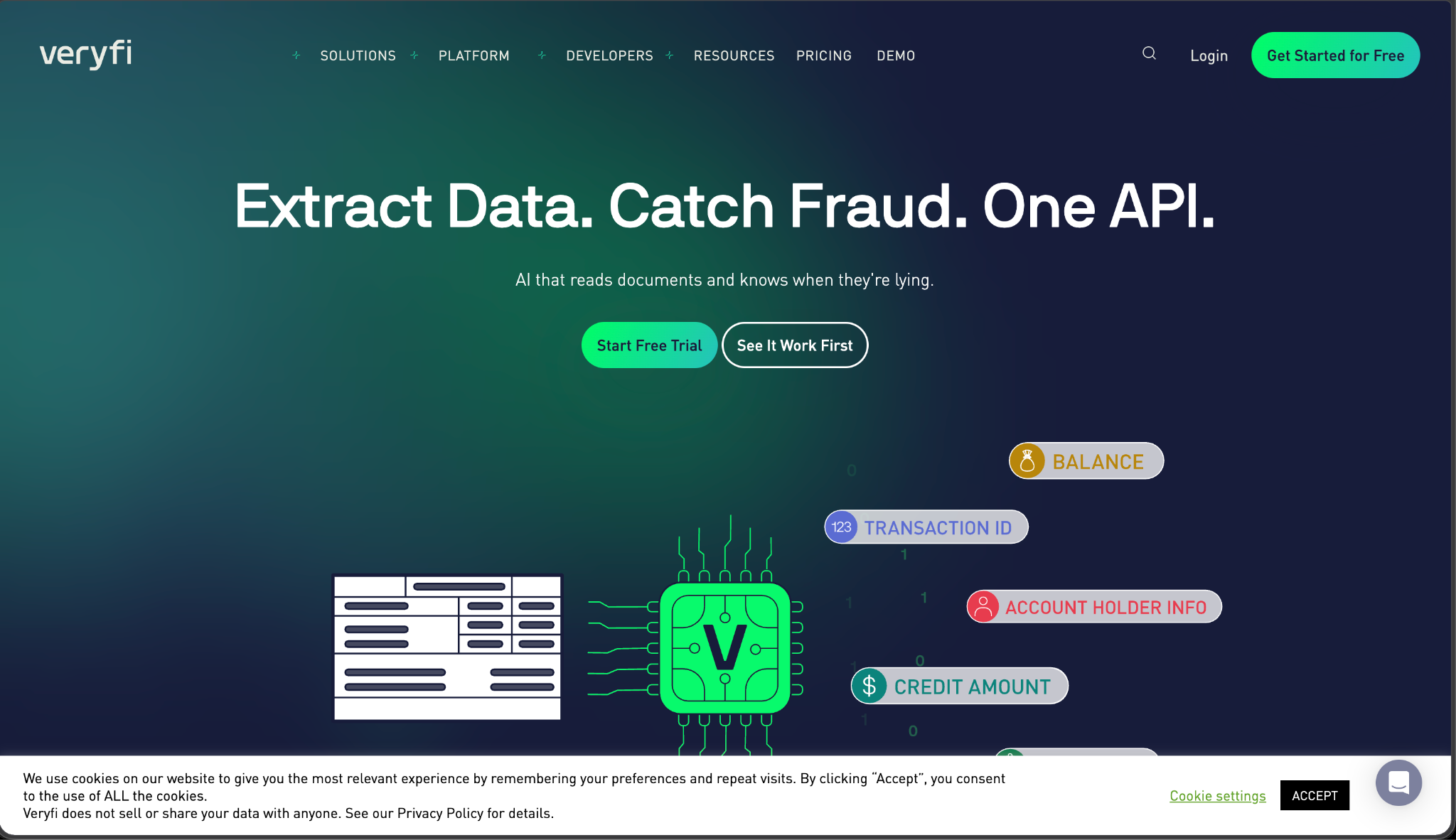
Best for: Product and engineering teams that need extraction for bank statements, checks, and other financial documents from several capture channels, with integrity checks running alongside extraction.
Veryfi is a document AI platform that turns financial and business documents into structured data. It processes receipts, invoices, bank statements, checks, and credit cards using OCR and natural language understanding, and it flags suspicious documents through integrity checks such as validating math and detecting duplicates, plus forensic analysis. Capture options include mobile SDKs, browser extensions, and API integrations, and SDKs cover Python, JavaScript, Java, Go, and other languages. More than 1,000 organizations use it, spanning accounts payable, expense management, and insurance claims.
Key Functionalities
- Integrity checks run alongside extraction. Math validation, duplicate detection, and forensic analysis flag suspicious documents.
- Multiple capture channels feed one pipeline. Mobile SDKs, browser extensions, and API integrations ingest documents from phones, email, and web uploads.
- On-device processing and offline capability keep data local where required.
- Security covers SOC 2 Type II, HIPAA, and GDPR, with a published 99.995 percent uptime SLA.
Pros:
- Fraud and integrity checks are part of the core product
- Broad SDK coverage across common programming languages
- 99 percent or higher accuracy claimed across document types, with a 14-day free trial
Cons:
- Its customer base leans toward accounts payable and expense management, so lending-specific analytics are limited compared with Ocrolus
- Pricing isn't published on the company's homepage
- Document coverage is broad across business documents, which may mean less depth on any single lending format
Pricing: Not published on the homepage. A 14-day free trial is available.
Verdict: A good fit for a team that wants fraud-aware extraction behind a developer API across several document types and capture methods. A team whose core need is deep mortgage or small business underwriting analysis will find Ocrolus more specialized.
5. Nanonets: Best for No-Code Workflow Automation
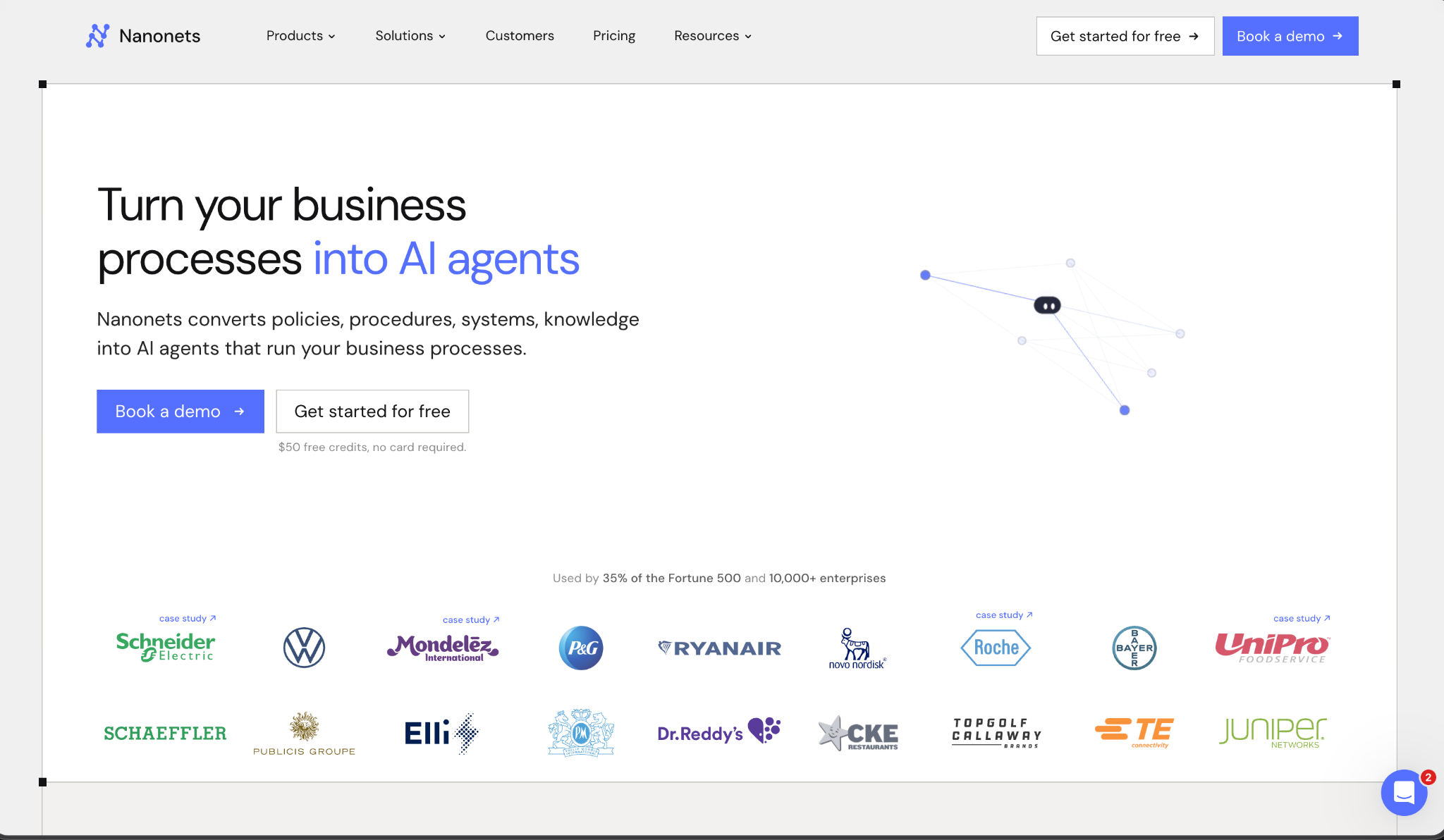
Best for: Finance and operations teams that want to build extraction and routing logic in a visual workflow builder without engineering support.
Nanonets combines OCR and deep learning models in a drag-and-drop workflow builder that uses AI blocks for extraction, classification, enrichment, and transformation. Conditional logic and custom Python blocks handle advanced rules, and native connectors cover systems such as SAP, Oracle Fusion, NetSuite, Dynamics 365, QuickBooks, Sage, Xero, Salesforce, and Zapier. The platform is built around workflow automation across finance operations, and invoices and accounts payable are the most common examples in its own materials.
Key Functionalities
- A visual workflow builder assembles extraction and routing without code.
- Credit-based pricing charges per block execution at roughly $0.02, $0.10, or $0.30 per run depending on block complexity.
- Native ERP, accounting, and CRM connectors move extracted data into existing systems.
- Enterprise deployment options include private cloud, on-premises, and SAML SSO, alongside HIPAA and SOC 2 compliance.
Pros:
- Strong no-code experience for non-technical operations teams
- Broad native connector coverage across ERP and accounting tools
- Credits never expire and are shared across a team
Cons:
- Pay-per-block pricing varies with workflow complexity, which makes cost harder to forecast
- Built around workflow automation rather than lending analytics such as cash flow or income calculation
- Highly irregular layouts and dense tables are more likely to hit limits in a no-code model
Pricing: The Starter plan includes $50 in free credits with no card required, then $100 per month for 100 credits. Growth pricing is volume-based and requires a sales consultation, with up to 40 percent volume discounts. Enterprise pricing is custom. Nanonets' own example puts a typical invoice workflow at under $2 per invoice end to end.
Verdict: A fit for a finance operations team that wants a visual builder tied to its ERP and accounting stack, working with fairly consistent documents. A lender with a broad, inconsistent bank statement and pay stub mix will likely outgrow the no-code model.
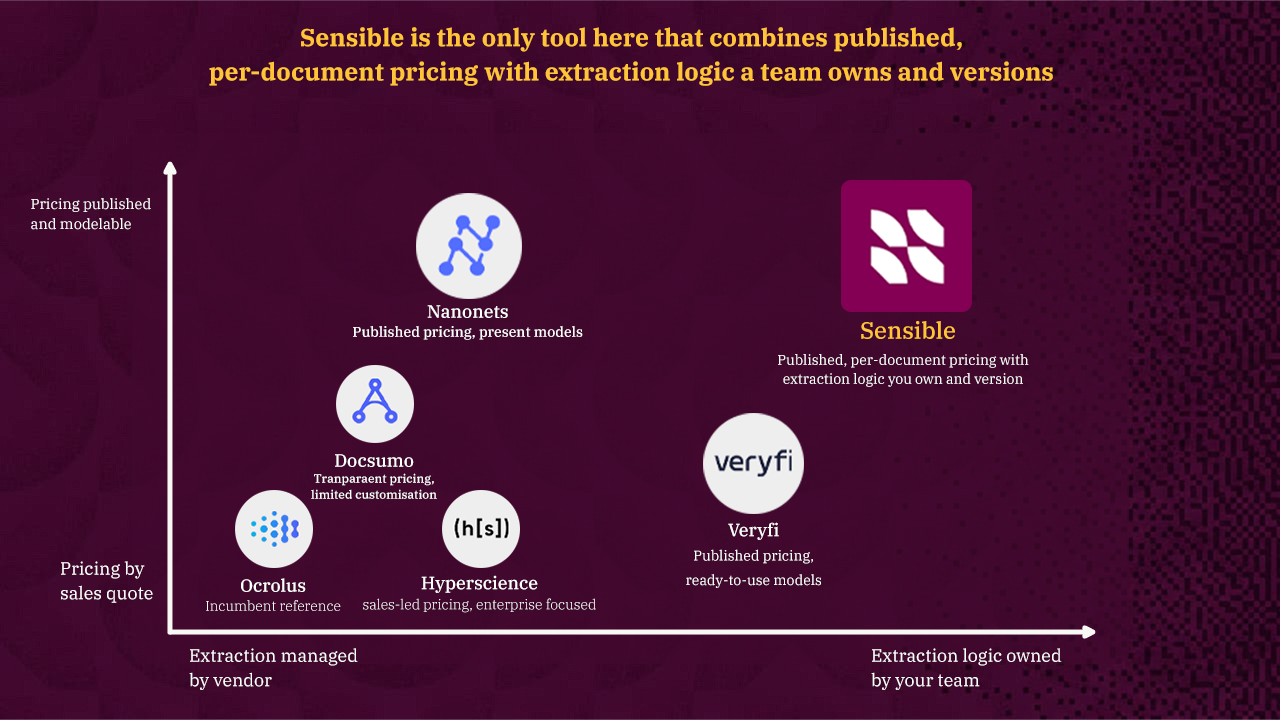
How Do These Five Ocrolus Alternatives Compare Side by Side?
Star ratings reflect strength within each dimension, not an overall rank. These five tools solve different parts of the financial services document problem, so no single tool wins across every dimension. "Not applicable" means the dimension sits outside what that platform is built to do.
Which Ocrolus Alternative Fits Your Team?
The comparison above shows what each tool does. The table below answers a narrower question: given a specific team profile, which tool fits.
Conclusion: Match the Tool to the Gap in Your Current Setup
Ocrolus remains a strong specialist for lenders that want bank statement analysis, fraud detection, and underwriting analytics from one vendor. The alternatives in this guide address the three places teams tend to outgrow it: extraction logic they want to own, document coverage beyond lending, and pricing they can model without a sales call.
Sensible fits teams that treat extraction as infrastructure, Hyperscience fits large institutions that want one accuracy-focused platform across departments, Docsumo suits standard formats, Veryfi pairs extraction with integrity checks, and Nanonets gives operations teams a visual builder. Teams weighing Sensible against Ocrolus can test it on their own bank statements and pay stubs with the free trial, which needs no credit card.
FAQs
What is the best alternative to Ocrolus for financial services teams?
Sensible is the strongest fit for teams that process varied financial documents and need fast results, with published per-document pricing and custom region deployment on Enterprise plans. Hyperscience suits large institutions, Veryfi suits teams that want fraud checks bundled with extraction, and Docsumo and Nanonets suit teams with standard formats or no engineering support.
Why do teams look for Ocrolus alternatives?
Common reasons include unpublished pricing, response time on human-reviewed documents, limited flexibility for document types outside lending, and deployment requirements such as keeping data in a specific region. Reviewers on Capterra also mention slow processing on some banks and occasional missed fields that need manual checking.
Does Ocrolus publish its pricing?
No. Ocrolus doesn't publish rates, and third-party estimates place per-statement costs roughly between $0.50 and $2.00 on annual contracts. Sensible, Docsumo, and Nanonets publish at least some pricing detail, while Hyperscience sells through a sales-led process.
Which Ocrolus alternative includes fraud detection?
Veryfi runs integrity checks such as math validation, duplicate detection, and forensic analysis alongside extraction. Hyperscience lists fraud pattern detection and deduplication for financial services, and Ocrolus offers its own tampering detection. Sensible validates and reconciles fields and traces each to its source, and teams that need dedicated tampering detection can pair it with a specialist layer.
Can Sensible handle bank statements from many different banks?
Sensible runs layout configurations for bank statement formats it has already mapped, plus a general LLM configuration that handles everything else, with the same output schema either way and line-level transaction extraction. Pay stubs from ADP, Gusto, Paychex, and Intuit, and common tax forms are also covered.
Is per-document or per-page pricing better for long financial documents?
Per-document pricing stays flat as page count grows, which helps on long statements and packets. Per-page pricing, which Docsumo uses, rises with every added page. A team should model its own average document length against each vendor's pricing before comparing totals.
Can Sensible be deployed in a specific region for data residency?
Yes, on Enterprise plans. Sensible lets customers select their preferred AWS region and, per its security overview, has supported data-residency requirements with custom deployments. Teams with regional compliance needs should confirm the specifics with Sensible’s team.
How does response time compare when human review is part of the process?
According to Sensible’s comparison page, Ocrolus’s mode that includes human review takes minutes to hours, while Sensible returns results from configured extraction without a back-office review step. In its Shepherd case study, a 351-page loss run came back in 31 seconds.